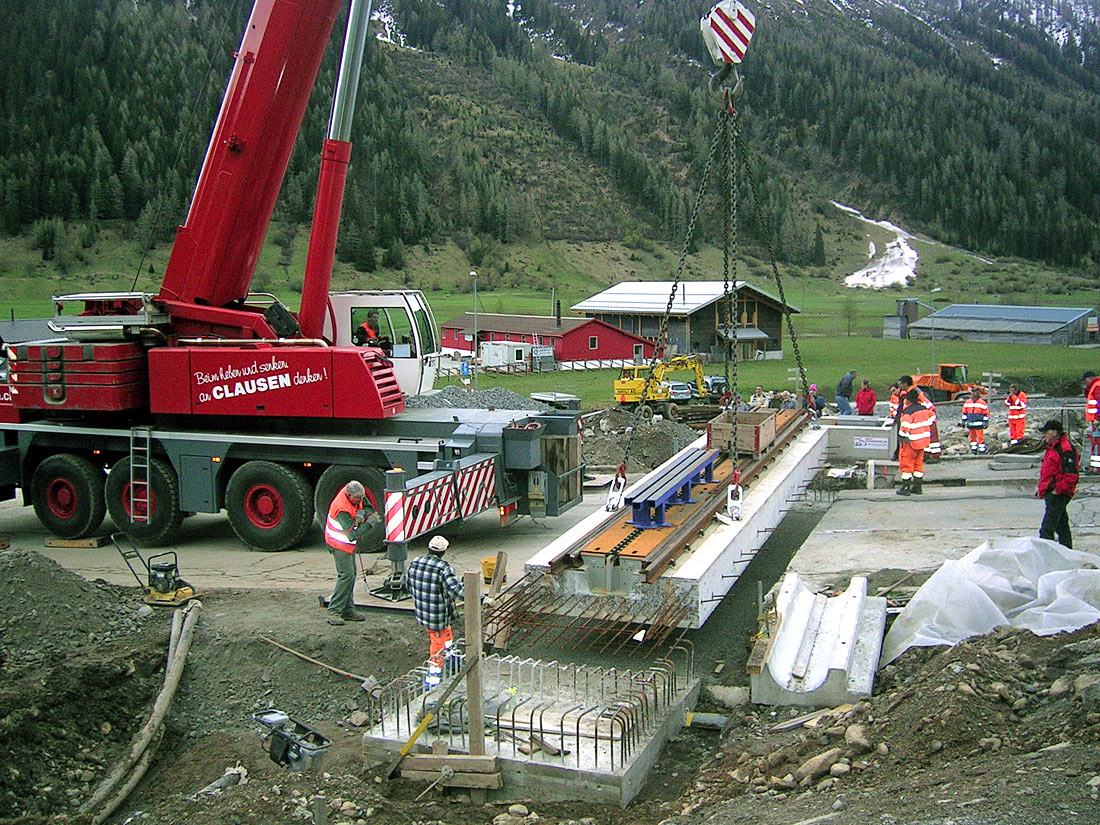
C’est dans la nuit du 6 au 7 mai 2010 qu’a été installé le passage à niveau qui permet au train Dampfbahn Furka Bergstrecke (DFB) de franchir la route du col de la Furka à Oberwald.
Ce passage à niveau a été construit et assemblé à Münchenbuchsee, près de Berne, dans les locaux de Baumgartner AG. Une fois terminé, vérifié et qualifié, la pièce de 36 tonnes a été transportée par route jusqu’à Oberwald.
Rappelons que ce passage à niveau est unique puisqu’il est équipé d’une crémaillère rétractable. En effet, la crémaillère Abt est rétractée de telle façon que ses dents ne dépassent pas le niveau de la chaussée de la Furka afin de ne pas gèner la circulation des voitures et des motos. Lorsque la barrière se ferme pour le passage du train, alors la crémaillère se met en position haute pour permettre à la locomotive un engrènement continu sur la pente. Une fois le que train a franchi la route, la crémaillère se rétracte sous le niveau de la chaussée et les barrières se relèvent.
Oberwald, level crossing with retractable cog
During the night May 6th/7th 2010, the level crossing was installed across the Furka road at Oberwald. So now the Dampfbahn Furka Bergstrecke (DFB) is able to reach the final station of the line after quite 30 years of work! The level crossing was built and assembled at Baumgartner AG, Münchenbuchsee near Bern. When it was finished, verified and qualified, the 36 tons part was moved on a truck to Oberwald.
This level crossing is really unique because it is made up with a retractable cog. The Abt cog is retracted so its teeth are under the level of the Furka road so that the cars and bikes can cross the level crossing. When the level crossing gate is closed, the cog is raised above the road so the train can have a continuous cog on the slope. When the train passed through the road, the cog is lowered under the road and the barriers are raised.
Passage à niveau avec crémaillère rétractable / Level crossing with retractable cog
A Oberwald, la ligne DFB rejoint enfin la gare MGB d’Oberwald. Il ne reste plus qu’à terminer l’embranchement menant à la plaque tournante qui permet de tourner les locomotive de 180°.
At Oberwald, now the DFB railroad is going to the MGB station. There is one branch line left to do, those which leads to the turntable.
Gare d'Oberwald DFB et MGB / Oberwald DFB and MGB train station
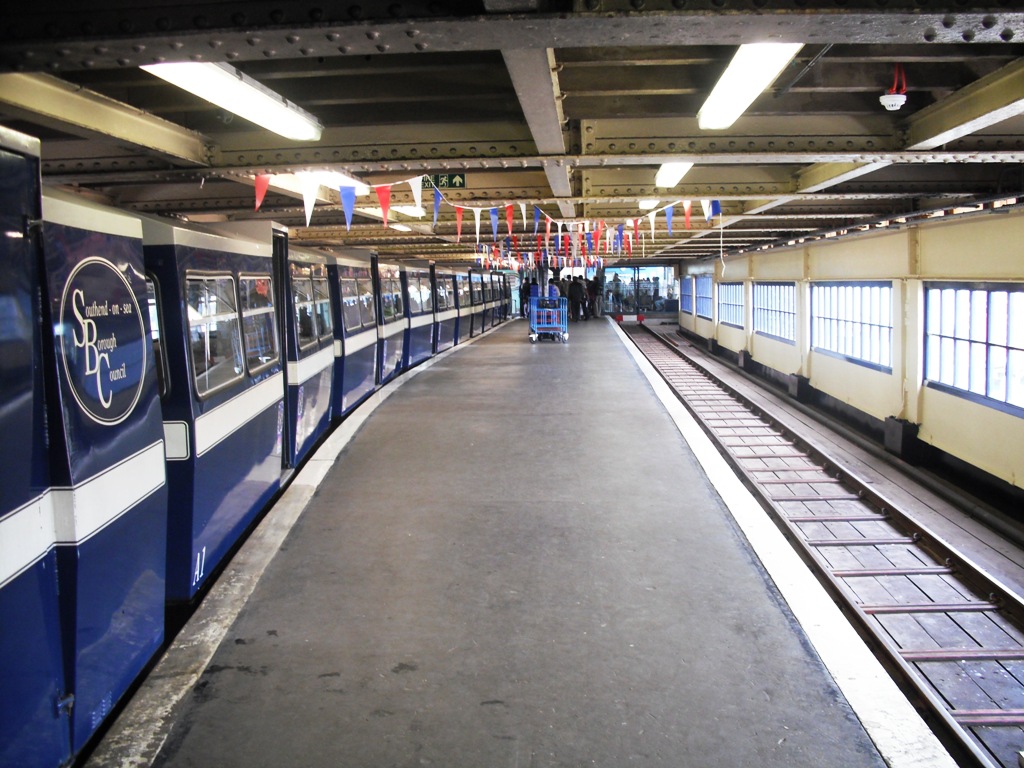
At last, the Southend Cliff Lift has reopened on Tuesday 25th May 2010!
It reopened with a new carriage, a new tracks, a new winding gear and electrical and control systems.
The Cliff Lift was originally opened for the first time on August Bank Holiday Monday 1912. The Lift replaced one of the first examples of a moving walkway in the country that was installed in 1901, Although a radical and innovative idea it proved to be noisy, uncomfortable and unreliable.
The Cliff Lift is a true counter-balanced funicular railway, the counter-weight ingeniously located under the carriage running on a separate track. The Lift was constructed by Waygood and Co. and was an immediate success.
In 1990 further improvements were carried out including a third new carriage with side mounted door and new access ramps that improved access for pushchairs and the disabled. In 2003 a malfunction with the counter-weight brought operations to a halt and the Cliff Lift was out of action for a period of 7 years. Investigations revealed major corrosion to the structure that would take some time and money to correct.
In the meantime Southend-on-Sea Borough Council received funding from the Heritage Lottery Fund to restore the Cliff Gardens including the Lift stations. The work on the stations including new roofs and decorative ironwork was completed in 2006.
Réouverture du Southend Cliff Lift
Le funiculaire Southend Cliff Lift a finalement été enfin remis en service le mardi 25 mai 2010!
L’unique voiture a été changée ainsi que la voie, les poulies et les systèmes de contrôles électriques.
Le funiculaire avait été mis en service pour la première fois en août 1912. Il avait remplacé un des premiers systèmes d’escalier mécanique du pays qui avait été mis en service en 1901 bien que très innovant mais qui été finalement très bruyant, inconfortable et peu sûr.
Le nouveau funiculaire est un vrai système à contrepoids, celui-ci se déplace sur une voie spéciale située sous la voie de la voiture. Le système avait été conçu par Waygood and Co. et fut un succès immédiat.
En 1990 la voiture fut changée pour la troisième fois avec l’ajout d’une porte latérale et l’accessibilité aux fauteuils roulants. En 2003 un problème sur le contrepoids obligea à arrêter l’exploitation du funiculaire. Des examens révélèrent de gros problèmes de corrosion au niveau de la structure qui nécessitèrent du temps et de l’argent pour être réparés au bout de 7 années. Entre temps la municipalité de Southend-on-Sea récolta des fonds de l’Heritage Lottery Fund pour restaurer les jardins et le funiculaire. Les deux stations ont été restaurées en 2006.
Cliff Lift in action / Le funiculaire en serviceThe track and the lower station / La voie et la gare basseThe counterweight / Le contrepoidsPier Hill LiftsPier train / Le train de la jetée
Pier train / Le train de la jetée
Photos Dave Carson
Map
A – Southend Cliff Lift
B – Pier Hill Lifts
C – Pier train
New HD videos from my last visit to Switzerland two weeks ago.
First two videos of the famous Funicular Territet – Glion which was first opened in 1883 and then a video, taken at Glion, of the Cogwheel train which goes to the “Rochers de Naye” above Montreux and the Lake Geneva.
Nouvelles vidéos – Funiculaire Territet – Glion
De nouvelles vidéos HD de ma dernière visite en Suisse il y a deux semaines.
Tout d’abord, deux vidéos du célèbre funiculaire Territet – Glion qui fut mis en service en 1883 et ensuite une vidéo du chemin de fer à crémaillère du train des Rochers de Naye, au dessus de Montreux et du lac Léman, en gare de Glion en correspondance avec le funiculaire.
You are not unaware that the football World Cup 2010 will take place from June 11 to July 11, 2010 in South Africa.
In Durban, a new stadium is being built: the Moses Mabhida Stadium, named after the former leader of the Communist Party of South Africa.
Its main feature is a great arch which surmounts and crosses the stadium from one end to the other. This arch has a shape which is similar to the ‘Y’ which is on the flag of South Africa. A three branches arch. The branch of the arch which corresponds to the foot of the ‘Y’ supports an rope inclined lift, the SkyCar. Opened stairways are located in the other two branches of the arch.
The Skycar has been built by Garaventa and put into service in 2009. The slope of the arch varies and the cabin remains horizontal.
During the last two months of operation there were two incidents. The latest incident, on Monday April 26 2010, the passengers were bloched at the top of the arch for two hours. In attempting to descend the stairs, a woman felt faint. It must be said that the opened stairway is composed of 550 steps.
It is possible to walk up to the top of the arch via the SkyWalk, the staircase on the opposite side of the elevator. The climb up is done with a safety harness.
Vous n’êtes pas sans ignorer que la Coupe du monde de football 2010 se déroulera du 11 juin au 11 juillet 2010 en Afrique du Sud.
A Durban, un nouveau stade vient d’être construit: le Moses Mabhida Stadium qui porte le nom de l’ancien chef du parti communiste sud-africain.
Sa principale caractéristique consiste en une immense arche qui surmonte et traverse le stade d’un bout à l’autre. cette arche a une forme qui s’apparente au ‘Y’ du drapeau de l’Afrique du Sud. Une arche à 3 branches. La branche de l’arche qui correspond au pied du ‘Y’ supporte un ascenseur incliné funiculaire, le SkyCar. Des escaliers à ciel ouvert sont logés dans les deux autres branches de l’arche.
Le SkyCar a été construit par Garaventa et mis en service en 2009. La pente de l’arche varie et la cabine reste toujours horizontale.
Durant les deux derniers mois de l’exploitation il y a eu deux incidents. Le dernier en date a bloqué les visiteurs au sommet de l’arche pendant deux heures. En tentant de redescendre par les escaliers, une femme a fait un malaise. Il faut dire qu’il y a 550 marches à ciel ouvert.
Il est possible de monter à pied au sommet de l’arche en empruntant le SkyWalk, l’escalier situé de l’autre côté de l’ascenseur. La montée à pied se fait avec un baudrier de sécurité.
New Funimag article (Page) / Nouvel article Funimag (Page)
The Khojak Rope Inclines (Pakistan)
In the nineteenth century, after the second Anglo-Afghan war, a series of rope inclines were built by the British in Baluchistan (now in Pakistan).
An episode completely forgotten and totally unknown which is interesting to highlight when the Afghanistan and Pakistan are in the spotlight.
Follow the link below for the complete study of the Khojak Rope Inclines…
Au XIXème siècle, après la deuxième guerre Anglo-Afghane, une série de funiculaires furent construits par les britanniques au Balouchistan (Aujourd’hui au Pakistan).
Un épisode complètement oublié et totalement inconnu qu’il est intéressant de ressortir des oubliettes au moment où l’Afghanistan et le Pakistan sont au cœur de l’actualité.
Suivez le lien ci-dessous pour l’étude complète des funiculaires du tunnel de Khojak…
If you want to comment, please feel free to leave your comment at the end of the article.
Si vous souhaitez laisser un commentaire, vous pouvez le faire à la fin de l’article.