First rebuilding (1902-1911) / Première reconstruction (1902-1911)
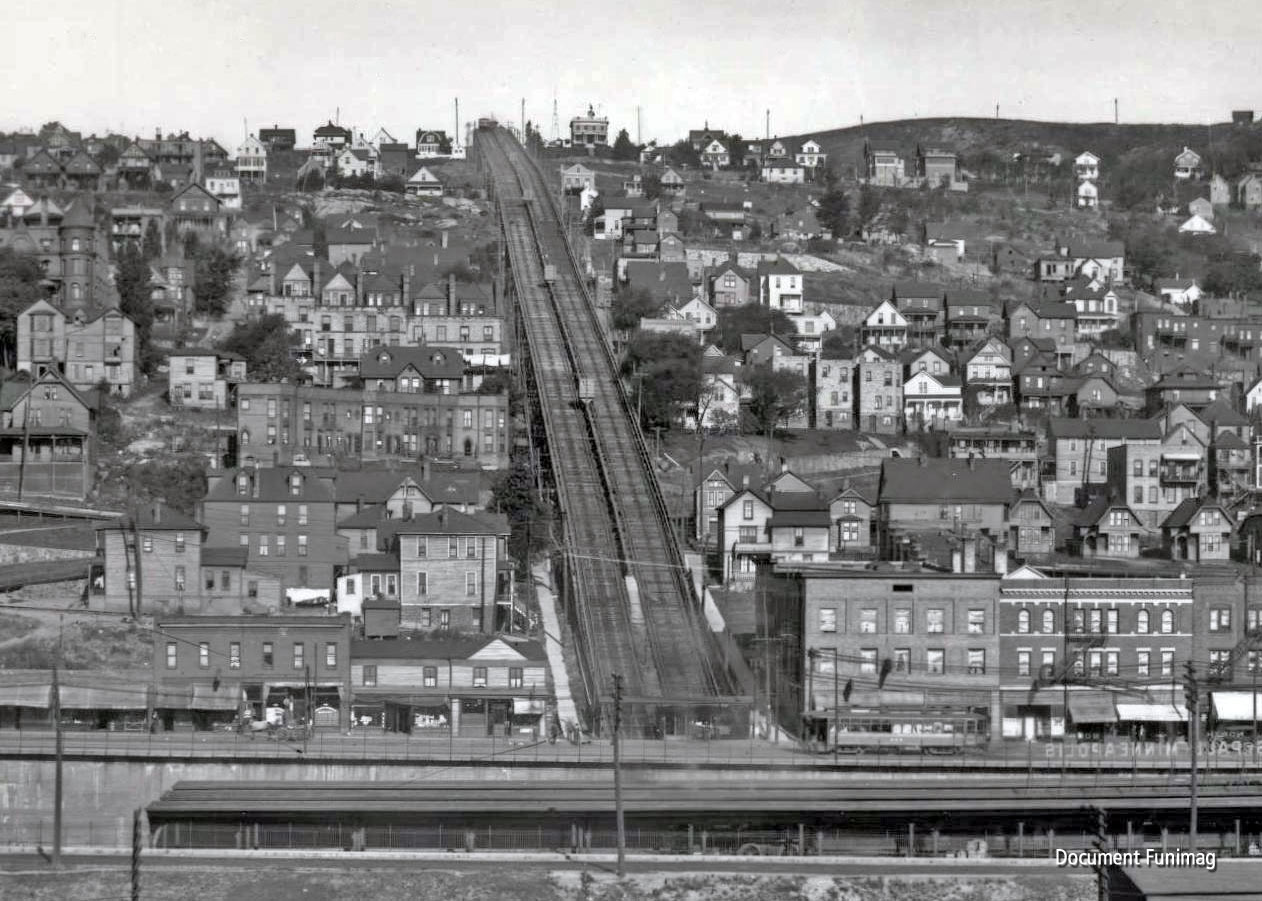
Six months after the fire and the crash of the right (east) car, the service was restored but with only one car, the left (west) car. The steam engine was replaced by an electric power station.
This car (N° 163) was a new car quickly built from a street car body mounted on a platform.
On the right track, the second car was replaced by a flat counterweight which was just four wheels carrying a weight!
Four bridges were built over the east track to gain access to the car whose entrance was not on the front of the car but on the right side, the interior side!
Six mois après l’incendie et le crash de la voiture Est, le service a été rétabli mais avec une seule voiture, celle de la voie de gauche (Ouest). La machine à vapeur a été remplacée par une motorisation électrique. La voiture (n°163) a été construite à la va-vite à partir d’une caisse de tramway posée sur un chariot. Sur la voie de droite, la voiture a été remplacée par un chariot bas sur lequel est posé un contrepoids. Quatre passerelles ont été construites au dessus de la voie de droite pour accéder à la voiture de gauche dont la porte est sur le côté intérieur!
(click on the picts to enlarge / cliquer sur les photos pour les agrandir)
1905- Rebuild of the incline with one car / Reconstruction du funiculaire avec une voiture
On the photo you can see the four bridges over the right track corresponding to the four intermediary stops. These bridges do not allow any right car except a flat counterweight which passed below the bridges!
At the real top of the right track you can see the flat counterweight… the flat counterweight is at the end of the line. there is no more top station hangar.
Sur la photo on peut voir les quatre passerelles qui passent au dessus de la voie de droite pour accéder aux quatre arrêts intermédiaires. Ces passerelles empèchent la circulation d’une voiture sur la voie de droite… par contre elles permettent la circulation du chariot contrepoids qui passe sous les passerelles! Au sommet de la voie de droite on aperçoit d’ailleur le chariot. Il n’y a plus de hangar à la gare supérieure.

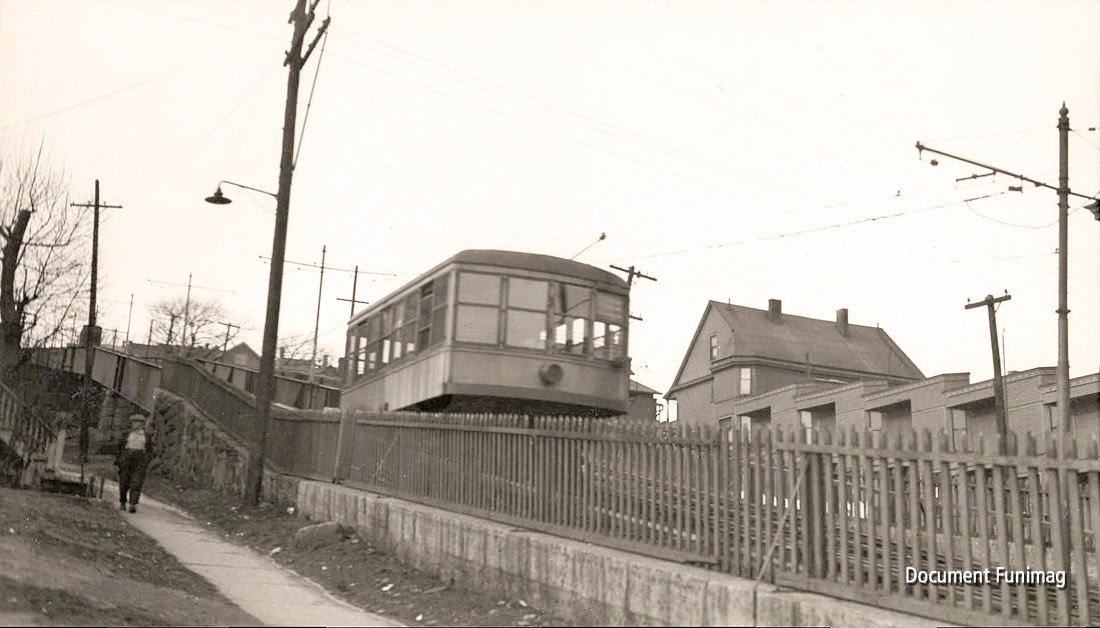
1905 – The car with the counterweight / La voiture avec le contrepoids
The car N° 163 which looks like a small street car. Note the only door on the interior side of the car and note also one of the four bridges over the right track which was used to access the car at the intermediary stops. A trolley wired was used to supply power for lightning.
La voiture n° 163 ressemble à celle d’un petit tramway. Il n’y a qu’une porte d’accès située sur le côté intérieur de la voiture. En haut de la voie de droite on aperçoit une des quatre passerelles d’accès aux stations intermédiaires. La voiture est équipée d’une perche de trolley pour alimenter l’éclairage de la voiture.

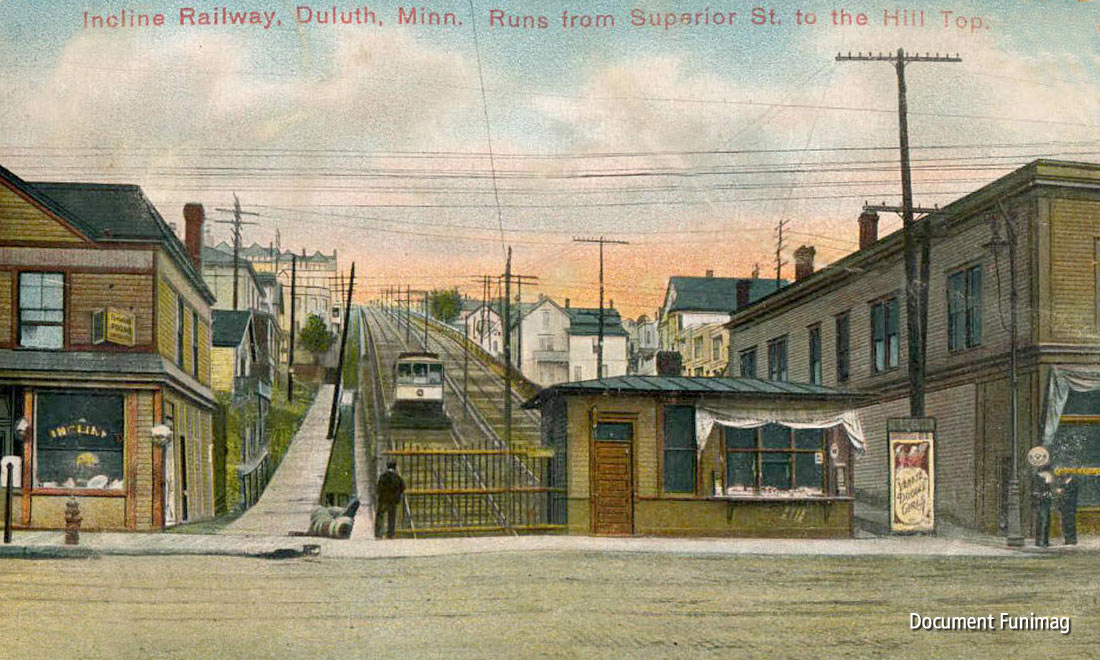
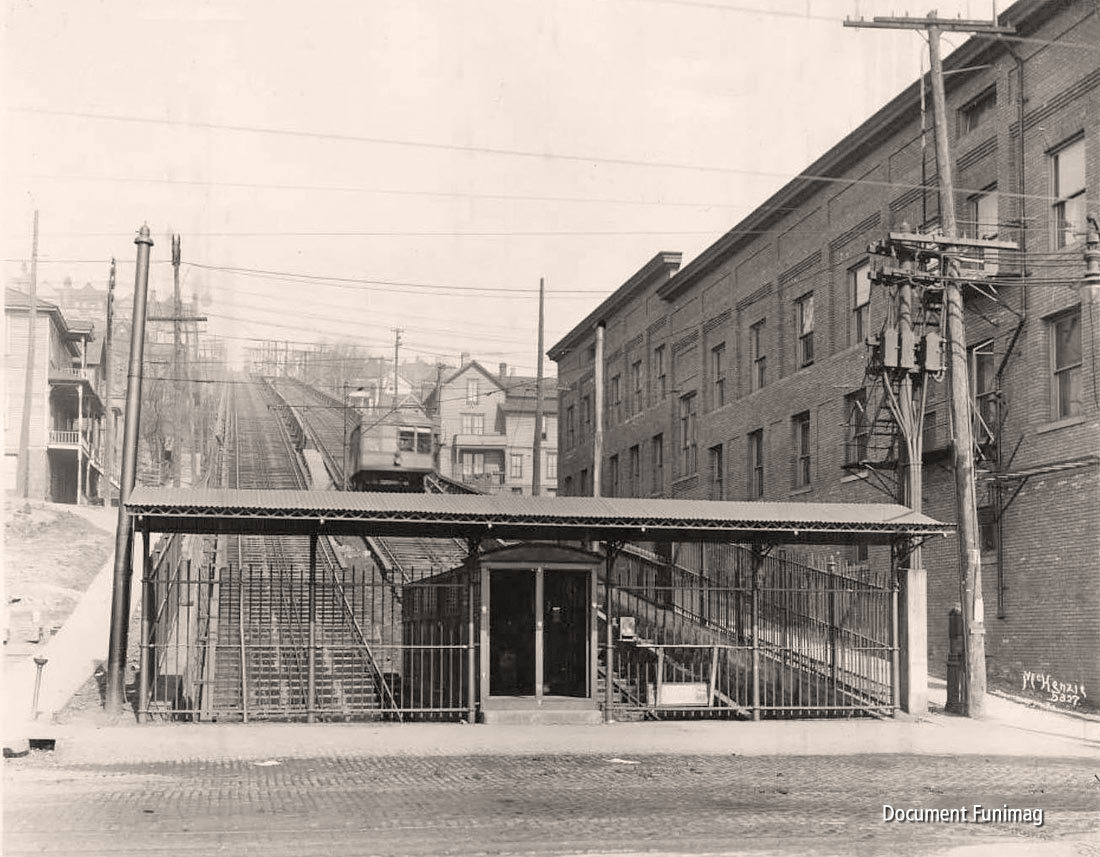
1905 – The new bottom station / La nouvelle gare basse
Note that the new bottom station was built over the end of the right track!
To access the car of the incline, the passengers had to use the narrow door. The wooden gate on the left side is not a door any more.
La nouvelle gare basse comprend aussi une petite boutique sur le bas de la voie de droite inutilisée! Pour accéder à la voiture, les passagers utilisent la porte étroite. La barrière en bois sur la gauche n’est plus le portail d’accès à la voiture.
Second rebuilding (1912-1939) / Seconde reconstruction (1912-1939)
This makeshift incline continued until 1911 until two new cars, designed especially for the incline were put in service in 1912.
Ce funiculaire improvisé continua son service jusqu’en 1911 jusqu’à ce qu’il soit équipé des deux nouvelles voitures spécialement conçues et qui furent mises en service en 1912.

1912 – The new incline / le nouveau funiculaire
You can see the two new cars: one at the top on left track, the second at the bottom station on the right track. Note also that the four bridges have been removed and replaced by four tiny intermediary stations located between the two tracks! To access these stations, passengers used stairs located below the tracks.
On aperçoit les deux nouvelles voitures: une au sommet de la voie de droite et l’autre en bas de la voie de droite. A noter aussi que les quatre passerelles ont été supprimées et remplacées par quatre petites stations intermédiaires situées entre les deux voies! On accédait à ces station par des escaliers sous la voie montée sur piliers.

1914 – The new bottom station / La nouvelle gare basse
The small shop have been removed and now the bottom station is symmetrical.
Note the roof… I am quite sure there was such a roof at the bottom station in 1901 when the car crashed! On the photo of the Quiz #25 we can see such a roof in the middle of the street…
La petite boutique a été supprimée et la gare basse est maintenant symétrique.
A noter le toit… je suis persuadé qu’il y avait un tel toit à la gare basse en 1901 au moment du crash du funiculaire! Sur la photo du Quiz #25 on voit un tel toit qui a été projeté au milieu de la rue…

1926 – The top station / La gare supérieure
This is a very interesting document! It shows the top station which is really minimalist!
On the left the east car stopped at the end of the track. To exit/enter the cars, passengers used a small platform located between the tracks. Below the track, the small cube is the power house… above the cube is a small shack used for the operator… over the heads of the couple, the waiting room which looks similar to the four intermediary tiny stations… on the right, the Highland Avenue street car.
C’est une photo très intéressante!
On y voit la gare supérieure qui est vraiment minimaliste!
A gauche la voiture Est est arrêtée en bout de voie. Pour accéder aux voitures, les passagers utilisaient une petite plate forme située entre les deux voies. Sous la voie, le bâtiment en forme de cube abrite la salle des machines… au dessus du cube, une petite baraque utilisée par l’opérateur… au dessus de la tête du couple qui pose, la salle d’attente qui ressemble fortement aux quatre stations intermédiaires… à droite le tramway d’Highland Avenue.

1926 – The Highlang Avenue street car / The tramway de Highlang Avenue
The same top station but the photo was taken from the Highland Avenue. On the foreground this is the Highland Avenue street car ans you can see the west car od the incline in the background on the right.
Même gare supérieure mais vue depuis Hihland Avenue. Au premier plan le tramway d’Highland Avenue et en arrière plan à droite on voit la voiture ouest du funiculaire.

1939 – The new car / La nouvelle voiture

1939 – Lake Superior and the Aerial Lift Bridge of the Duluth harbour / Le lac Spérieur et le pont levant du port de Duluth
Duluth is more well known for its Aerial Bridge which preceded the actual Aerial Lift Bridge.
Duluth est encore plus célèbre pour son pont transbordeur qui précéda le pont levant actuel.
See a great shot of the Aerial Bridge (1905) / Ci-dessous une superbe vue du pont transbordeur (1905):

1905 – The Aerial bridge / Le pont transbordeur
See also a great shot of the Aerial Bridge from the great SHORPY site.
Voir aussi cette superbe photo du Aerial Bridge sur le très interessant site SHORPY.

1939 – The last days / Les derniers jours
Everything is written on the bottom station! This photo is so sad… the incline seems to have no more success… the operator seems desperately waiting for passengers!
Tout est écrit sur la gare basse: “Dernière chance – Ne loupez pas cette fameuse excursion – Vue sur les ports jumeaux, à 100 mètres au dessus – Même tarif que le tramway – Le funiculaire va bientôt être supprimé pour cause de modernisation des transport”
The incline closed on September 4, 1939.
Le funiculaire a été fermé le 4 septembre 1939.
The photos are from the Minnesota Digital Library and with a big work for rebuilding!
See also these posts / Voir aussi ces articles:
Duluth, 7th Avenue West Incline – Solution of Quiz #25 (Part 1)
Belt Line Incline – Duluth, Minnesota