Funimag Photoblog, Funimag’s former blog, has just been completely modernized, reorganized, and updated. It now focuses on in-depth articles about funicular railways. You’ll find old articles there, along with new ones that will be published regularly. In the archives, you’ll find all the news published in recent years in the form of posts. As for new news, you’ll now find it, and have been for several years now, on Funimag’s social media channels, particularly on X (formerly Twitter) and BlueSky.
Below are the previously published in-depth articles…
American people do not know and have forgotten that the United States of America have built the most spectacular funiculars but they have practically all disappeared.
It’s something that’s totally unknown, but there was a funicular in the same place as early as 1875, before the very famous one in Montmartre. It was used to build the Sacré-Coeur Basilica.
Le plan incliné des Eaux-Bonnes, aussi appelé plan incliné Valentin-Hourat, est certainement un des plans inclinés funiculaires les plus inconnus en France.
1826, the first railway and the first inclined railway were used to transport granite toward Boston for the purpose of erecting Bunker Hill Monument to commemorate the famous 1775 battle.
The United States of America was a great country of funiculars (inclines) but American people do not know or have forgotten these lost American funiculars.
The United States of America has built the most spectacular funiculars but they have practically all disappeared for a long time.
Here are more than fifty lost or stopped funiculars in order to remember what was the great era of American funiculars. This list is not exhaustive and is just a selection of the most representative ones.
Located on Catalina Island off Los Angeles, the incline was used to link Avalon and the amphitheater to Pebbly Beach on the other side of the hill.
Catalina Island (1904-1923)
Court Flight (1905-1943)
Court Flight incline was the other funicular in downtown Los Angeles. Not so famous as Angels Flight, which was opened in 1901 and is still active, Court Flight funicular linked Bunker Hill to Court Street.
Court Flight (1905-1943)
Fairfax Manor (1913-1930)
Fairfax Manor Incline Railroad was used to access Manor Hill near Redwood in Marin County and promote promote sell lots.
Fairfax Manor (1913-1930)
Los Angeles – Mount Washington (1909-1919)
The Los Angeles & Mount Washington Railway was a funicular which was built to develop the summit of Mt. Washington Hill.
Los Angeles – Mount Washington (1909-1919)
Mount Lowe (1893-1937)
The Mount Lowe Great Incline was part of a great set of railways built to reach top of Mt. Lowe from Pasadena near Los Angeles.
Mount Lowe (1893-1937)
Playa Del Rey (1901-1909)
This funicular was built to access the beach from Playa Del Rey, between the actual Marina Del Rey and Los Angeles International Airport.
Playa Del Rey (1901-1909)
San Francisco – Fillmore Hill (1895-1941)
The Fillmore Hill incline was an independent counterbalance funicular to climb from Broadway to Green and was not connected to the classical San Francisco cable cars.
San Francisco – Fillmore Hill (1895-1941)
San Francisco – Telegraph Hill (1884-1886)
As Fillmore Hill, The Telegraph Hill incline was an independent counterbalance funicular to climb from Broadway to Green and was not connected to the classical San Francisco cable cars. It ran on Greenwich Street from Powell to the Pioneer Pavilion.
San Francisco – Telegraph Hill (1884-1886)
Shasta Springs (1898-1950)
Shasta Springs was a famous resort near Mount Shasta volcano in North California.
Shasta Springs (1898-1950)
Colorado
Golden Castle Rock (1913-1918)
Golden Lookout Mountain (1912-1916)
In 1912, the first funicular of Golden was built at top of the Lookout Mountain Park.
Golden Lookout Mountain (1912-1916)
Mount Manitou Incline Railroad (1907-1989)
Mount Manitou incline is certainly the most famous of US disappeared funiculars may be because it was recently closed. Its empty track is today used for vertical runs.
Mount Manitou Incline Railroad (1907-1989)
Manitou Red Mountain (1912-1925)
Few meters only from the famous Mount Manitou Incline and the Pike Peak Cog Railway, there was may be the most unknown US funicular… the Manitou Red Mountain Incline.
Manitou Red Mountain (1912-1925)
Mount Morrison (1909-1914)
The Mount Morrison Incline Railroad was also an unknown and ephemeral funicular but as spectacular as those from Manitou Spring.
Mount Morrison (1909-1914)
Royal Gorge Incline (1931-2013)
The Royal Gorge Incline was in operation since recently but was forced to stop because of big damage after fire in the area.
Royal Gorge Incline (1931-2013)
Seven Falls (….-1992)
Located near Colorado Springs, the Seven Falls is a famous natural spot. A funicular was first built to help visitors to access the gorge… today it is replaced by an underground vertical lift.
Seven Falls (….-1992)
Florida
Tampa Harbour Island People Mover (1985-1999)
A very short life for this cable Automated People Mover which was built to link the Harbour Island to downtown Tampa in Florida. Today, every thing is gone.
Tampa Harbour Island People Mover (1985-1999)
Iowa
Dubuque Eleventh Street (1883-1927)
On 11th Street there was the second funicular of Dubuque which was less famous than Fenelon Place Elevator which is on 4th Street.
Dubuque Eleventh Street (1883-1927)
Michigan
Kalamazoo Western Michigan College (1908-1949)
This funicular was located inside Western Michigan University of Kalamazoo. In 2002 a replica was built by some students but it is only a static exposition.
Kalamazoo Western Michigan College (1908-1949)
Macatawa Lookout Pavillion (…-…)
The Angel’s Flight Inclined Railway of Macatawa was built to reach the top of Lookout Point over Lake Michigan.
Granite Railway and Incline– The first railroad in America (1826-1940)
Granite Railway & Granite Incline were located south of Boston. They were the first railway and the first inclined railway in America. They were built in 1826 transport granite stone from Quincy quarry to erect the Bunker Hill Monument of Boston for the fiftieth anniversary of the Battle of Bunker Hill. More details about Granite Railway and its incline
Granite Railway and Incline– The first railroad in America (1826-1940)
Mount Holyoke Summit House (1858-1951)
A tramway and a covered funicular was built to transport tourists to the Mont Holyoke Hotel at the top of the hill.
Mount Holyoke Summit House (1858-1951)
Mount Tom Railroad (1897-?)
Located new Holyoke, a railroad and a funicular were built to reach the summit of the Mount Tom above the western bank of the Connecticut River.
Mount Tom Railroad (1897-?)
Montana
Lewis and Clark Caverns (1947-1973)
Lewis and Clark Caverns were first accessible with a Jeep railway and a funicular. Unfortunately both of them were forced to close for administrative reasons.
Lewis and Clark Caverns (1947-1973)
North Carolina
Ghost Town in the Sky (1961-2002)
Ghost Town in the Sky is a Wild West-themed amusement park on top of a mountain in Maggie Valley which was accessible by a double funicular composed of four cars of 48 passengers each. The park is now accessible by two chairlifts.
Ghost Town in the Sky (1961-2002)
New Hampshire
Cranmore Skimobile (1938-1989)
Cranmore Skimobile was composed of 192 cable hauled cars in two sections to transport skiers and sightseers on top of Mount Cranmore in North Conway (New Hampshire).
Cranmore Skimobile (1938-1989)
Uncanoonuc Incline Railway (1907-1941)
Uncanoonuc Incline Railway and Development Company built an electric railway from Goffstown to the top of Mount Uncanoonuc near Manchester (New Hampshire).
Uncanoonuc Incline Railway (1907-1941)
New Jersey
Hoboken wagon lift (1874-1928)
The Hoboken wagon lift was a funicular used to lift vehicles from the foot of Paterson Plank Road to Jersey City Heights and close to the famous Hoboken Elevated Railway railway trestle.
Hoboken wagon lift (1874-1928)
Morris Canal Inclined Planes (1830-1924)
The Morris Canal was a 172 km canal used to transport coal on boats from Delaware river to Hudson river at Jersey City. There was 23 water-driven inclined planes the Morris Canal.
Morris Canal Inclined Planes (1830-1924)
Weehawken wagon lift (1892-?)
The Weehawken wagon lift was a funicular used to lift vehicles from the foot of Hackensack Plank Road to West Hoboken (now Union City).
Weehawken wagon lift (1892-?)
West Orange Cable Road (1892-1906)
The West Orange Cable Road was a cable railway up the mountain in West Orange.
West Orange Cable Road (1892-1906)
New York
Harriman Mansion (1904-1925)
Edward Henry Harriman (1848–1909) director of the Union Pacific Railroad had a mansion built (today Arden House) on the heights of Turner (today Harriman, Orange County) with a funicular with a steam powered hoist to access it.
Harriman Mansion (1904-1925)
Lake George Prospect Mountain (1895-1903)
The Lake George Prospect Mountain railway was built by Otis to climb the top of Prospect Mountain west from Lake George City.
Lake George Prospect Mountain (1895-1903)
Mount Beacon Incline Railway (1901-1978)
The Mount Beacon Incline Railway was a funicular railroad up to Mount Beacon at Beacon on left bank of Hudson River.
Mount Beacon Incline Railway (1901-1978)
New York – Brooklyn Bridge Cable Railway (1883-1908)
At New York, Brooklyn Bridge is very famous as highway to cross East River but many people have forgotten that at the beginning there were special train shuttles that gripped a cable driven by a static steam engine and were then moved to the other track by steam locomotives for the next departure (From 24-Sep-1883 till end 27-Jan-1908).
New York – Brooklyn Bridge Cable Railway (1883-1908)
Knickerbocker Ice Company mined the ice from Rockland Lake and to transport the blocks of ice to New York needed to build a steam-powered funicular to cross Hook Mountain and down to the Hudson River.
Rockland Lake Knickerbocker Ice Co. (1860-1924)
Sea Cliff Incline Railway (1886-1907)
Located at Sea Cliff on Long Island, the Sea Cliff Incline Railway was used to transport passengers of steam boats from the dock to the top of the hill were was the Sea Cliff Hotel.
Sea Cliff Incline Railway (1886-1907)
Yonkers, Park Hill Elevator (1894-1937)
At Yonkers, near Otis headquarter, an Otis hydraulic inclined elevator was built to link two Victorian buildings in Park Hill between 83 Alta Avenue and 32 Undercliff Street.
Yonkers, Park Hill Elevator (1894-1937)
Ohio
Cincinnati
The city of Cincinnati is famous to have been a great city of 6 early big funiculars mainly capable to transport streetcars and other vehicles on the top of the hills but in 1948 all the inclines were gone!
Cincinnati / Bellevue Incline (1876-1926)
Also known as the Cincinnati & Clifton Inclined Plane Railroad, the Bellevue Incline was able to transport tramway and other vehicles from Elm Street at McMicken Avenue to Ohio Avenue.
Cincinnati / Bellevue Incline (1876-1926)
Cincinnati / Fairview Incline (1892-1923)
Cincinnati / Mount Adams Incline (1876-1948)
The Mount Adams & Eden Park Inclined Railway was the last and most famous funicular of Cincinnati. It was designed to transport street cars up to Adams Hill, the Zoo and Eden Park.
Cincinnati / Mount Adams Incline (1876-1948)
Cincinnati / Mount Auburn Incline (1871-1898)
The Mount Auburn or Main Street Incline was the first funicular of Cincinnati. First it was a passenger only incline than it was modified with an open platform to transport tramways and horse-driven vehicles.
Cincinnati / Mount Auburn Incline (1871-1898)
Cincinnati / Price Hill Inclines (1874-1943)
The Price Hill Inclines was composed of two separate funiculars. One was reserved for passengers only (on the left of the photo) and the other one was reserved for freight and vehicles.
Cincinnati / Price Hill Inclines (1874-1943)
Pennsylvania
Allegheny Portage Railroad (1834-1857)
The Allegheny Portage Railroad was a 36-mile railroad built to cross the Allegueny Moutains and to link Johnstown on Conemaugh River and Hollydaysburg near Altoona. The railroad was able to transport canal boats on rail and over the moutain with 10 funicular inclined planes.
The Hazleton Railroad was in charge to transport coal from Weatherly from top of the mountain down to the Lehigh River valley. Inclined planes were built at Penn Haven (actually Penn Junction) to reach the bottom of the valley.
Ashley Inclined Planes (1843-1948)
Penn Haven Inclines (1851-1864)
The Hazleton Railroad was in charge to transport coal from Weatherly from top of the mountain down to the Lehigh River valley. Inclined planes were built at Penn Haven (actually Penn Junction) to reach the bottom of the valley.
Penn Haven Inclines (1851-1864)
PITTSBURGH
Pittsburgh is unquestionably the American city that has had the most funiculars. The city counted up to 20 funiculars. Today there are only two: Monongahela Passenger Incline and Duquesne Incline.
Pittsburgh – Castle Shannon Incline (1890-1964)
The Castle Shannon Incline was carrying passengers and vehicles. It ran from Carson Street (near the present-day trolley tunnel) to Bailey Avenue on Mt. Washington. It was originally steam powered, and was converted to electric in 1918. Close to it there was also the Castle Shannon Coal Incline in charge to transport and the Castle Shannon South which was a kind of cable railroad to bring passengers to the main Castle Shannon Incline.
The Monongahela Incline which is still in use since 1870 is the oldest funicular in USA (right on the photo). In 1883 a second incline was built just on the left of the 1870 passenger incline. The Monongahela Freight Incline (left on the photo) was reserved for freight and vehicles and was dismantled in 1935.
The Mount Oliver Inclined Railway Company built an incline whose engine house was located on Mount Washington near Mount Oliver Street and down to the Southside.
The Norwood Incline (or Penny Incline because a penny was charged to use it) ran from Island Avenue near Adrian Street to Desiderio Avenue between McKinnie Avenue and Highland Avenue McKees Rocks/Stowe.
The Nunnery Hill Incline was the first curved track incline in Pittsburgh. It linked Federal Street at Henderson Street (formerly Fairmount Street), North Side, to Catoma Street near Meadville Street (formerly Clyde Street).
Pittsburgh – Nunnery Hill Incline (1887-1899)
Pittsburgh – Penn Incline (1883-1953)
The Penn Incline (or 17th Street Incline) was a freight, vehicles and passengers funicular railway from 17th Street between Liberty and Penn avenues in the Strip District to Arcena (Ridgeway) Street near Ledlie Street in the Hill District.
Pittsburgh – Penn Incline (1883-1953)
Pittsburgh – Knoxville Incline (1890-1960)
The Knoxville Incline was the longest incline in Pittsburgh with 806 meters and a curve in the middle of the track. It was designed to transport freight, vehicles and passengers from Arlington Ave at Warrington on Mt. Washington down to Bradish Street on Southside.
Pittsburgh – Knoxville Incline (1890-1960)
The links to the two remaining inclines of Pittsburgh still in use
The Shohola Glen Amusement Park in Pike County operated a switch back railroad from using passenger cars salvaged from the Pa. Coal Company Gravity Railroad that operated from Dunmore to Hawley. One section was an funicular inclined plane.
The Mauch Chunk, Summit Hill & Switchback Gravity Railroad was first designed to transport anthracite from mines on hills down to Lehigh River. In 1874, the railroad was transformed into a tourist attraction that became one of the first roller coasters. Tourists in cars were pulled up two hills (Mount Pisgah and Mount Jefferson) then the cars were released to follow the railroad by gravity.
Mauch Chunk Switchback Gravity Railroad – Mount Pisgah Incline (1827-1933)Mauch Chunk Switchback Gravity Railroad – Mount Jefferson Incline (1827-1933)
Tennessee
Chattanooga – Lookout Mountain First Incline (1886-1898)
The Lookout Mountain Incline was the first Incline (Incline n°1) at Chattanooga to climb to the Lookout Mountain at the old Point Hotel. This incline was located few meters beside the actual Lookout Mountain Incline (Incline n°2) which was built in 1896 and then replaced the incline n°1.
Chattanooga – Lookout Mountain First Incline (1886-1898)
The Kennecott Copper Mine (today Rio Tinto Kennecott) is famous for its big open pit mine near Salt Lake City. During decades inside this big pit there was a real village called Bingham Canyon with many railroads. The village was located at the bottom of the canyon and the train station was on the top of the hill. A funicular was built to reach the village from the train station until 1970 when the village was abandoned and destroyed to expand the open pit mine.
The Washington Hotel (first named Denny Hotel) was built in 1889 on top of Denny Hill. To reach the entrance of the hotel from Third Avenue a short inclined railway was built. The hotel was demolished in 1907 during the regrade of Denny Hill.
Seattle – Washington Hotel (1901-1907)
Diablo Dam – Skagit Incline (1920-2001)
May be one of the most spectacular inclined plane ever built. The Skagit Incline was part of the Skagit Electric railway and was built to carried loaded freight cars and locomotives broadside up the hill to the Diablo Dam. The inclined plane was stopped after September 11 2001 terrorist attack for security reason but is still visible.
Diablo Dam – Skagit Incline (1920-2001)
West Virginia
Mozart Park, Wheeling (1893-1907)
In 1893, a recreational park was built on top of the hill near Mozart area. To link the new Mozart Park to South Wheeling, an incline railway was built near 43rd Street. It operated until 1907 and was replaced by a street car. The Mozart Park itself remained open until 1917.
Mozart Park (1893-1907)
Wisconsin
Milwaukee Shorewood – Atwater Park (1967-1977)
At Shorewood, near Milwaukee, a funicular was built in 1967 at Atwater Park to reach the beach 30 meters down. The two carriages were names “Able Cable” and “Twinkle Toes”. The cliff railway was dismantled in 1987.
NEW ARTICLE IN FUNIMAG Today, in the fixed pages (Articles) of this blog, you will find a new article about the first railroad and the first inclined railway in America :
(US) Granite Railway – The first railroad in America (1826)
GRANITE RAILWAY & GRANITE INCLINE at Quincy, Massachusetts, USA
The story of the first railway and the first inclined railway in America (1826).
Built to transport granite stones from Quincy quarries to the Bunker Hill Monument at Boston.
(US) Granite Railway – Le premier chemin de fer d’Amérique (1826)
GRANITE RAILWAY & GRANITE INCLINE à Quincy, Massachusetts, USA L’histoire du premier chemin de fer et premier plan incliné funiculaire d’Amérique (1826). Construit pour transport des blocs de granit nécessaire à la construction du monument en mémoire à la bataille de Bunker Hill à Boston.
Pour commémorer la célèbre bataille de Bunker Hill qui, le 17 juin 1775, vit la victoire des Britanniques sur les troupes révolutionnaires à Boston lors que la guerre d’Indépendance, William Ticknor créa, en 1823, une association, the Bunker Hill Monument Association, dont le but était de trouver des fonds pour l’édification d’un obélisque de 67 mètres de haut à l’emplacement de la bataille. To commemorate the famous battle of Bunker Hill, June 17 1775, where the British defeated the revolutionary troops in Boston during the American Revolutionary War, William Ticknor created in 1823, an association, the Bunker Hill Monument Association, whose purpose was to raise funds for the construction of an 67 meters high obelisk at the site of the battle.
Battle of Bunker Hill by Percy Moran
Le granit nécessaire à la construction de l’obélisque fut trouvé dans une carrière de Quincy au sud de Boston. C’est le Marquis de La Fayette, en personne, qui, le 17 juin 1825, posa la première pierre du monument lors du cinquantième anniversaire de la bataille de Bunker Hill. Granite needed for the construction of the obelisk was found in a quarry in Quincy, south of Boston. This is the Marquis de La Fayette, in person, who, on 17 June 1825, laid the first stone of the monument on the fiftieth anniversary of the Battle of Bunker Hill.
Marquis de La Fayette in 1825
Le Bunker Hill Monument ne sera finalement achevé qu’en 1843. The Bunker Hill Monument will be finally completed until 1843.
Bunker Hill Monument in 1890 (document Library of Congress)
Les énormes blocs de granit nécessaires au monument furent transportés par des chariots tirés par des chevaux mais afin de les acheminer plus efficacement un projet encore plus audacieux fut monté… celui de construire un chemin qui supporterait et guiderait les chariots… un chemin de fer… le premier chemin de fer d’Amérique. Le 4 janvier 1826 fut créée The Granite Railway Company afin d’améliorer le transport des blocs de granit et c’est le 7 octobre 1826 que ce premier chemin de fer fut mis en service à Quincy. Il reliait la carrière de granit de Blue Hill, à Quincy, à la rivière Neponset, soit une distance de plus de quatre kilomètres. Sur ses voies circulaient des chariots, tirés par des chevaux, et transportant les blocs de pierre jusqu’à la rivière et de là ils étaient ensuite transportés en bateau jusqu’à Bunker Hill. The huge granite blocks necessary for the monument were transported by carriages pulled by horses but in order to more efficiently deliver an even more audacious project was set up … The project was to construct a road that would support and guide the carriages… a railroad … the first railroad in America. On January 4, 1826 was created The Granite Railway Company to improve the transport of granite blocks and on 7 October 1826 that first railway was put into operation in Quincy (MA). The railway linked the Blue Hill granite quarry at Quincy to the Neponset River at a distance of more than four kilometers. On its way circulating carriages, drawn by horses, and carrying stone blocks to the river and there they were then transported by boat to Bunker Hill.
Map 1867Granite railway and Granite Incline
Le chemin de fer fut conçu par Gridley Bryant. La voie était composée de blocs de granit sur lesquels étaient fixées des plaques de fer de 1,54 mètre de long en guise de rails. Un plan incliné fut construit pour descendre les blocs de granit depuis la carrière jusqu’au niveau du nouveau chemin de fer, soit un dénivelé de 25 mètres. The railway was designed by Gridley Bryant. The path was made of granite blocks on which were fixed iron plates of 1.54 m long as a track. An inclined plane was built for take down the granite blocks from the quarry to the level of the new railway, or a drop of 25 meters.
Monument for Granite Incline in 1934 (document Library of Congress)Granite Incline, details of the trackDetails of the remains of one of the two parallel inclined tracks with the pulleys which was supporting the chain (1934) (document Library of Congress)
Le plan incliné était composé de deux voies parallèles, une pour les chariots montant à vide et l’autre pour les chariots descendant chargés des blocs de granit. Entre les rails de chaque voie passait une chaîne sans fin qui reposait sur 39 poulies disposées environ tous les deux mètres. Au sommet du plan incliné, il y avait une plate forme oscillante, équipée d’une roue dentée et de cames, dont le rôle était de recevoir les lourds chariots en provenance de la carrière avant leurs prises en charge par le plan incliné. Lorsqu’un chariot arrivait sur la plate forme, celle-ci actionnait automatiquement une plaque qui s’élevait entre la pente et la plate forme pour empêcher le chariot de basculer dans la pente. Une fois que le chariot sortait de la plate forme, celle-ci reprenait sa position normale grâce à des contrepoids. En bas du plan incliné, une plaque tournante permettait de diriger les chariots depuis le plan incliné vers le chemin de fer. Ce plan incliné fut utilisé tel quel pendant 70 ans avant que les voies soient modernisées en 1901. En 1920, les rails d’origine furent enlevés et remplacés par une seule voie composée de rails en forme de cornières métalliques sur lesquelles pouvaient rouler des automobiles comportant un plateau pour les blocs de granit (voir photo ci-dessous) et qui étaient manœuvrées et retenues par un puissant treuil et des câbles. The inclined plane was composed of two parallel tracks, one for empty carts going up and the other for carts loaded of granite blocks going down . Between the rails of each track passed an endless chain lay on 39 pulleys arranged approximately every two meters. At the top of the incline, there was an oscillating platform, equipped with cams and a toothed wheel, whose role was to receive heavy carts from the quarry before their transportation by the inclined plane. When a cart arrived on the platform, it was operating an automatic plate which stood between the slope and the platform to prevent the trolley from falling into the slope. Once the carriage left the platform, it resumed its normal position by means of counterweight. Down the inclined plane, a hub allowed to direct trucks from the slope to the railroad. This inclined plane was used as such for 70 years before the tracks were modified in 1901. In 1920, the original rails were removed and replaced by a single path consisting of U shaped metal rails on which motorized trucks could drive with granite blocks (see photo below) and were operated and retained by a powerful winch and cables.
Granite Incline in 1920
Au total le plan incliné fut utilisé pendant plus de 100 ans. Les chariots étaient composés de quatre grandes roues de près de 2 mètres de diamètre avec une plate forme entre les roues. Pour prendre en charge les blocs de granit, la plate forme était posée seule sur le sol puis chargée avec les blocs de granit. Le chariot était ensuite amené au dessus de la plate forme qui était soulevée au dessus de la voie au moyen d’un treuil manuel et de chaînes. Un chariot pouvait transporter 6 tonnes de charge et être tiré par un seul cheval. Il fallait une heure et demie pour aller de la carrière au quai d’embarquement de la rivière et retourner à la carrière. The inclined plane was used for over 100 years. Carriages consisted of four large wheels nearly 2 meters in diameter with a platform between the wheels. To support the granite blocks, the platform was placed only on the floor and loaded with granite blocks. The carriage was then brought over and the platform was raised above the track using a manual winch and chains. A carriage could carry 6 tons load and be pulled by a single horse. It took an hour and a half to go from the quarry to the pier at the river and back to the quarry.
Replica of the first carriage of Granit Incline exposed on 1934Carriage of the Granite InclineCarriage of the Granite InclineCarriage of the Granite Incline
Le chemin de fer était considéré comme une grande réussite technique et les visiteurs venaient de loin pour en faire la visite. Ainsi, après 6 ans d’exploitation, est arrivé un évènement qui est considéré comme le premier accident de chemin de fer d’Amérique. Le 25 juillet 1832, quatre hommes quittèrent Boston pour venir examiner le chemin de fer. Après avoir vu comment étaient transportés les blocs de granit sur la voie, ils furent invités à visiter le plan incliné en s’installant dans un des chariots qui devait remonter à vide la pente. Durant la montée, la chaîne se rompit et les quatre hommes furent précipités dans la pente. Il y eut un mort, Thomas B. Achuas, et trois blessés graves. The Granite Railway was considered as a great technical achievement and visitors came from far away to make the visit. Thus, after six years of operation, came an event which is considered the first railway accident in America. July 25, 1832, four men left Boston to come and examine the railway. After seeing how were transported granite blocks on the way, they were invited to visit the inclined plane by moving one of the carts had to go back empty slope. During the climb, the chain broke and the four men were thrown into the slope. There was a death, Thomas B. Achuas and three seriously injured.
Plaques commémoratives du centenaire sur les colonnes du monument du Granit Incline (1826-1926): Commemorative plaques for the centenary of the Granit Old Incline (1826-1926):
A gauche / Left: Premier chariot du Granit Railway. Premier chemin de fer en Amérique / First car on the Granite Railway. First railway in America
A droite / Right:
Ce portail indique le pied du vieux plan incliné qui a fait partie du chemin de fer du granit (Granit Railway). Ce chemin de fer a été conçu et réalisé par Gridley Bryant malgré une forte opposition et soutenu par Thomas Perkins Handasyd pour le transport de la pierre pour le Bunker Hill Monument depuis les carrières jusqu’à la rivière Neponset à une distance de 2,75 miles. Les travaux ont commencé en avril 1826 et le chemin de fer a été terminé et mis en service octobre 7 1826. This gateway marks the foot of the Old Incline, a part of the Granite Railway. The idea of this railway was conceived and carried out by Gridley Bryant in the face of great opposition but supported by Thomas Handasyd Perkins to transport the stone for Bunker Hill Monument from the quarry to tidewater in Neponset River a distance of two to three quarters miles. Work was begun April 1826 and the completed railway was opened October 7 1826.
Caractéristiques du plan incliné / Technical datas of the Granit Incline:
A contrepoids
/ Counterbalanced
Début: 7 octobre 1826 / Start: October 7, 1826 Fin: années 1940 / End: 1940s Dénivelé: 25 mètres / Difference of altitude: 25 meters Longueur: 96 mètres / Longueur : 96 meters Pente: 26,8 % / Gradient: 26.8 %
Vidéo sur l’emplacement du Granite Railway / Video at the Granite Railway site
Lettre A rouge: le plan incliné (Granit Incline) / Letter A in red: Granit Incline Cliquez et zoomez sur les autres repères pour en connaître la signification / Click and zoom on the other tags to know what they are
Plan incliné de la carrière de la Caudelette à l’Estaque, Bouches du Rhône, France (1969)
Inclined plane of the Caudelette Quarry at L’Estaque, Bouches du Rhône, France (1969)
Plan incliné de la carrière de la Caudelette (1969) (photo Jean-Henri Manara)
Il s’agit du plan incliné funiculaire de la Carrière de la Caudelette à l’Estaque – Riaux, près du port de Marseille, dans le département des Bouches du Rhône (France). La photo a été prise en 1969. Le plan incliné passait au-dessus de la route D568 au niveau de l’actuel parking de Bleu Calanque Nautisme, près de l’entrée du tunnel du Rove. Le plan incliné jouxtait l’ancienne usine Kuhlmann que l’on voit en haut à droite sur la photo. Aujourd’hui il ne reste rien de ce funiculaire ni des usines. Tout a été rasé et tout l’emplacement des anciennes usines de l’Estaque est en cours de dépollution.
This is the inclined plane, Of the Caudelette Quarry at l’Estaque – Riaux, near Marsseille, in the department of Bouches du Rhône (France).
The photo was taken in 1969.
The inclined plane passed over the road D568 at the actual Calanque Blue Boating parking, near the entrance of the Rove tunnel.
The inclined plane adjoined the old factory Kuhlmann we see at the top right of the photo.
Today nothing remains of the funicular or factories. Everything has been shaved and the location of all the old l’Estaque factories is under chimical cleanup.
Funiculaire de la carrière de la Caudelette et usine Kuhlmann. (Document www.riotinto.fr)
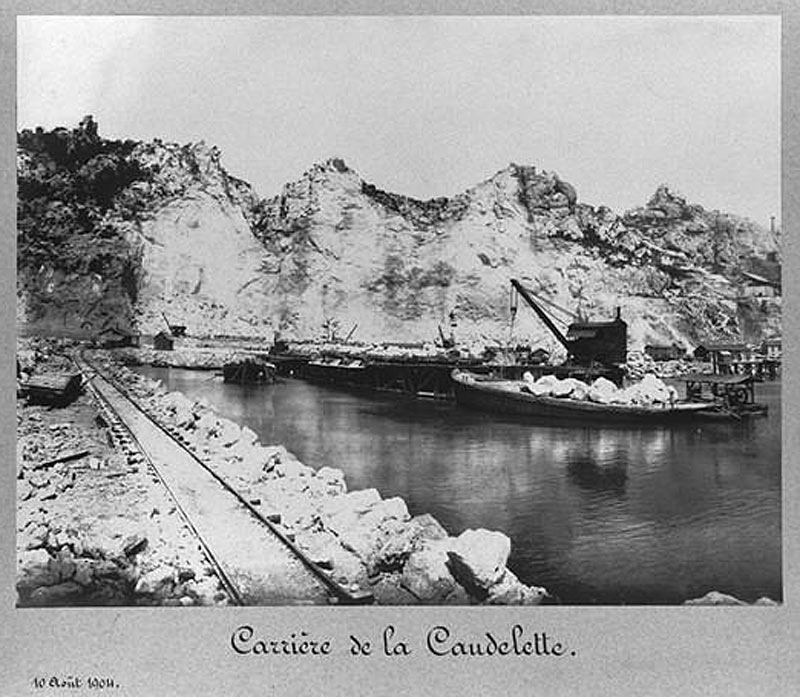
Carrière de la Caudelette (1904) (source gallica.bnf.fr)
Géolocalisation / Geolocation
Etat actuel / Actual state
Actuellement, grâce à Google StreetView, on peut constater qu’une partie du plan incliné est encore visible. Une gros bloc de béton armé incliné est encore présent juste au dessus de la route D568 comme on peut le constater sur la vue ci-dessous:
Today, with Google StrretView, we can see that a part of the inclined plane is still visible.
A large block of concrete slope is still present just above the D568 road as you can see on the picture below: