Funimag Photoblog, Funimag’s former blog, has just been completely modernized, reorganized, and updated. It now focuses on in-depth articles about funicular railways. You’ll find old articles there, along with new ones that will be published regularly. In the archives, you’ll find all the news published in recent years in the form of posts. As for new news, you’ll now find it, and have been for several years now, on Funimag’s social media channels, particularly on X (formerly Twitter) and BlueSky.
Below are the previously published in-depth articles…
American people do not know and have forgotten that the United States of America have built the most spectacular funiculars but they have practically all disappeared.
It’s something that’s totally unknown, but there was a funicular in the same place as early as 1875, before the very famous one in Montmartre. It was used to build the Sacré-Coeur Basilica.
Le plan incliné des Eaux-Bonnes, aussi appelé plan incliné Valentin-Hourat, est certainement un des plans inclinés funiculaires les plus inconnus en France.
1826, the first railway and the first inclined railway were used to transport granite toward Boston for the purpose of erecting Bunker Hill Monument to commemorate the famous 1775 battle.
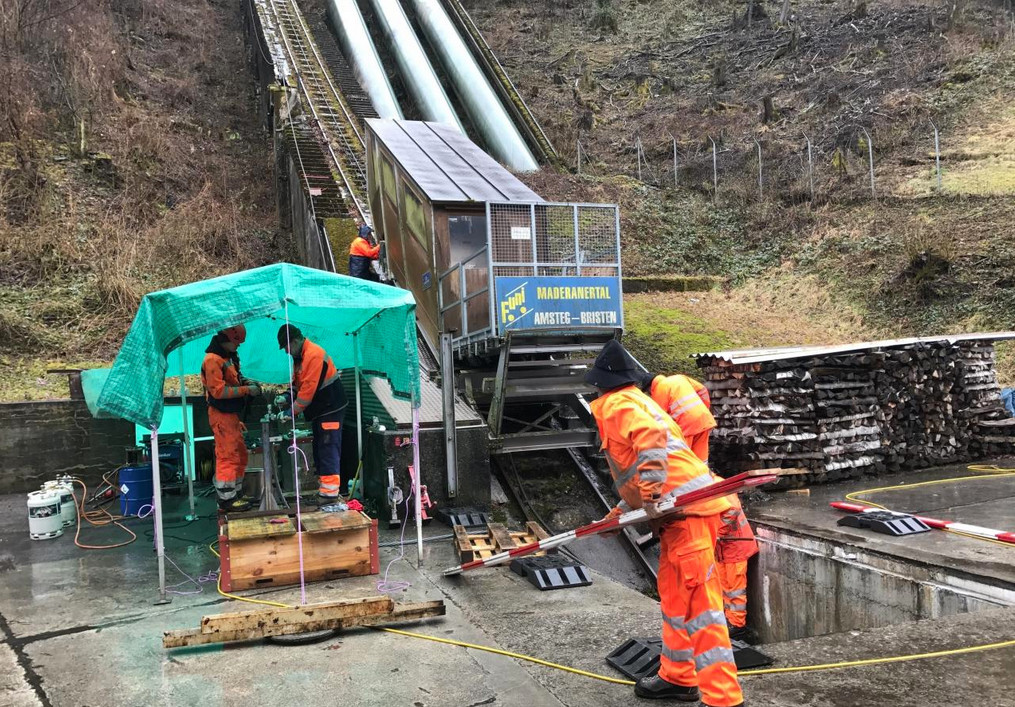
Work on funicular before reopening / Travaux sur le funiculaire avant sa réouverture (Photo 20Minuten-Nicole Agostini)
Where the road collapsed / Où la route s’est effondrée
On 6 March 2017, the Amsteg – Bristen road collapsed at practically the same location where a rock was dynamited in April 2003.
The road has to be repaired and secured which will certainly take several weeks.
The village of Bristen is thus completely isolated. As in 2003, the only connections between Bristen and the valley are the trails and the helicopter.
The former funicular of Amsteg power station will therefore resume service to bring people into the valley.
In 2003, Garaventa had completely renovated and equipped the 1918 funicular to carry passengers.
After the reopening of the road in mid-June 2003, the funicular was finally stopped.
This year the funicular will be awakened, checked and restarted from 15 March 2017 until the Amsteg – Bristen road is reopened again.
Le funiculaire de la centrale électrique d’Amsteg va reprendre du service
Le 6 mars 2017, la route Amsteg – Bristen s’est effondrée pratiquement au même endroit où un rocher avait été dynamité en avril 2003. La route doit être réparée et sécurisée ce qui va prendre certainement plusieurs semaines. Le village de Bristen se retrouve donc complètement isolé. Comme en 2003, les seules liaisons avec Bristen sont les sentiers pédestres et l’hélicoptère. L’ancien funiculaire de la centrale électrique d’Amsteg va donc reprendre du service pour amener les personnes dans la vallée. En 2003, Garaventa avait complètement rénové et aménagé le funiculaire, qui datait de 1918, pour pouvoir transporter des passagers. Après la réouverture de la route mi juin 2003, le funiculaire avec été arrêté définitivement. Cette année, le funiculaire va donc être réveillé, vérifié et remis en service à partir du 15 mars 2017 jusqu’à ce que la route Amsteg – Bristen soit de nouveau ré-ouverte.
Une pétition a été ouverte pour la”Remise en circulation du funiculaire de Super Cannes !“
Si vous vous sentez concernés par le sauvetage et la remise en service du funiculaire de Super-Cannes, nous vous engageons à signer cette pétition sur le site de CHANGE.ORG dont vous avez le lien ci-dessous:
Mise en ligne dans Funimag d’un nouvel article concernant le funiculaire qui a servi à la construction de la basilique du Sacré-Coeur de Montmartre à Paris en 1875… suivez ce lien!
I have just published a new article concerning a funicular which was used for the construction of Basilica of Sacred-Heart at Montmartre in Paris in 1875… follow this link!
La basilique du Sacré-Coeur à Paris, qui domine la butte Montmartre depuis la fin du XIXème siècle, est un haut lieu du tourisme parisien. Les touristes du monde entier y montent en empruntant le non moins célèbre funiculaire de Montmartre. La basilique a été construite entre 1875 et 1921. La première pierre est posée le 16 juin 1875 et la nef est inaugurée en 1891. La décision de construire le funiculaire fut prise en 1891 et sa mise en service date de 1900. Cependant très peu de gens savent qu’il y a eu un funiculaire à cet endroit là bien avant 1900. En effet, un funiculaire de chantier a été construit dès 1875 pour faciliter la construction de la basilique. Il n’y a pratiquement pas d’informations sur ce funiculaire de chantier mais voici comment l’on peut le décrire sans trop se tromper. Il occupait quasi exactement l’emplacement du funiculaire actuel. Il était composé de deux voies parallèles sur lesquelles roulaient deux plates formes contrebalancées. Ces plates formes pouvaient accueillir chacune un chariot qui transportait les pierres servant à la construction de la basilique. Le chariot était chargé de pierres en bas du funiculaire à l’aide d’une grue de chantier actionnée manuellement par un homme. Une fois le chariot hissé en haut de la pente du funiculaire il était tiré par un cheval sur une voie ferrée de chantier de type Decauville pour être amené vers les tailleurs de pierres autour de la basilique en construction. En haut du plan incliné, un bâtiment à trois fenêtres arrondies et une grande cheminée abritait la machine à vapeur qui actionnait le treuil du funiculaire. Il semble que cette machine à vapeur soit la seule machine ayant servi à construire la basilique. Les autres sources d’énergie étant les chevaux tirant les chariots et les hommes qui actionnaient manuellement les différentes grues du chantier de la basilique.
The funicular for the construction of the Basilica of the Sacred Heart (Paris, France)
The Basilica of the Sacred Heart in Paris, which dominates Montmartre hill since the late nineteenth century, is a mecca of tourism in Paris. Tourists from around the world ascend via the equally famous Montmartre funicular. The basilica was built between 1875 and 1921. The first stone was laid on June 16, 1875 and the nave was inaugurated in 1891. The decision to build the funicular was taken in 1891 and it opened for the public 1900. However, very few people know that there was a funicular at the same place well before 1900. Indeed, a funicular was built in 1875 to facilitate the construction of the basilica. There is quite no information about this funicular but here’s how we can describe it. It was almost at the exact place of the present funicular. It consisted of two parallel tracks on which rolled two counterbalanced platforms. These platforms can each transport a trolley carrying the stones used in the construction of the basilica. The trolley was filled of stones at the bottom of the funicular with a crane which was manually operated by a man. Once the trolley hoisted to the top of the slope of the funicular it was pulled by a horse on a Decauville type railway to be brought to the stone cutters around the basilica under construction. At the top of the incline, there was a building with three arched windows with a high chimney. In the building a steam engine was operating the winch of the funicular. It seems that this steam engine is the only power machine that was used to build the basilica. Other energy sources are horses pulling the trolleys and men who manually operated different cranes on the site of the basilica.
Vue générale du funiculaire en 1877 / General view of the funicular in 1877
Vue générale du funiculaire du chantier de la basilique. Il occupait l’emplacement de l’actuel funiculaire de Montmartre. Le célèbre escalier de la rue Foyatier n’existait pas encore. General view of thefunicular for the constructionof the basilica.It occupiedthesite of the currentMontmartre funicular. The famousstaircase of theFoyatierstreet did not exist yet at that moment.
Guinguette “A l’échelle de Jacob” / “A l’échelle de Jacob” tavern
La guinguette “A l’échelle de Jacob” se trouvait aux n°2 et 2bis de la rue Berthe qui, en 1877, commençait en escaliers à partir de la rue Foyatier. En 1925, la guinguette fut rasée et remplacée par un immeuble de 6 étages. In 1877, the tavern “A l’échelle de Jacob” was located at #2 and #2bis inBerthestreet which began at that time with a staircasefrom theFoyatierstreet.In 1925,the tavernwas demolishedand replaced bya 6-levels building.
Haut du funiculaire / Top of the funicular
En haut du funiculaire, le bâtiment à trois ouvertures arrondies abritant la machine à vapeur et le treuil. Derrière le bâtiment on notera la haute cheminée de la machine à vapeur et à gauche en arrière plan les toits de l’église Saint-Pierre de Montmartre. At topof the funicular, the buildingwith three openingsrounded windows sheltered thesteam engine andthe winch.Behind the buildingwe note thehigh chimneyof thesteam engine andin the background on the left the roof of thechurch of Saint-Pierre de Montmartre.
Bas du funiculaire / Bottom of the funicular
En bas du funiculaire les chariots portés par les plates formes du funiculaires étaient chargés de pierres à l’aide de cette grue de chantier munie d’un treuil à chaîne actionné manuellement par un seul homme. At the bottomof the funicularthe trolleys carried by the platformsofthe funicularwereloaded with stonesusinga craneequipped with amanually operatedchain hoistby one man.
Haut du funiculaire / Top station of the funicular
Superbe photo montrant en détail la gare haute du funiculaire devant le bâtiment abritant la machine à vapeur et le treuil du funiculaire. A noter, au centre de la photo, le jeune homme s’appuyant sur le levier qui commande le blocage de la plate forme de la voie de gauche. A droite, on aperçoit le levier qui commande le blocage de la plate forme de la voie de droite. Superb pictureshowing in detailthe upperstationof the funicular in front of thebuilding sheltering thesteam engine andthe winchof the funicular.Note, in the center of the photo,the young manpressing the leverthat controls thelockingof the platformof theleft track.Tothe right isthe lever thatcontrols thelockingof the platformof theright track.
Détail de la plate forme / Detail of the funicular carriage
Gros plan sur une des deux plates formes du funiculaire supportant un chariot chargé de transporter les pierres de la basilique. A noter le cavalier prêt à tirer le chariot avec une chaîne pour l’atteler aux autres chariots qui attendent en arrière plan. Focus onone of theplatformsof the funicularcarrying atrolleyto transportthe stonesof the basilica.Note thethe man on the horse readyto pullthe trolleywith a chaintocouple othertrolleys waitingin the background.
Haut du funiculaire / Top station of the funicular
Ci-dessus, le bâtiment à trois ouvertures arrondies abritant la machine à vapeur et le treuil du funiculaire. Derrière le bâtiment on notera la haute cheminée de la machine à vapeur et derrière on aperçoit le chevet de l’église Saint-Pierre de Montmartre. Above,the building with thethree rounded windows sheltering the steam engine andthe winchof the funicular.Behind the buildingwe note thehigh chimneyof thesteam engine and we can seebehind theSaint-Pierre de Montmartre church.
Voies du chantier de la basilique / Railways for the construction of the basilica
En haut du funiculaire, un train de chariots tirés par un cheval sur une voie de type Decauville du chantier de la basilique. A noter la date, juin (jiun!) 1877, directement gravée sur la plaque négative de la photo par le photographe Louis-Émile Durandelle. At the top of thecable car,atrain of trolleys pulled bya horseon aDecauvilletype track for the constructionof the basilica.Notethe date,June(Jiun!) 1877engraveddirectlyon the negativeplatephoto by the photographerLouis-Émile Durandelle.
Chantier de la basilique / Construction of the basilica
Détail du chantier de la basilique montrant les voies de type Decauville parcourant tout le chantier pour y amener les chariots chargés de pierre devant deux grues portiques roulant sur leurs propres voies ferrées à écartement large. En haut du portique se trouve un chariot mobile roulant sur rails et portant un treuil à bras. A la fois le treuil, le chariot sur le portique et l’ensemble grue portique étaient mus manuellement. En arrière plan à droite, le bâtiment avec la haute cheminée abritant la machine à vapeur et le treuil du funiculaire. Detail of the constructionof the basilicashowingDecauvilletype tracks all around the sitein order tobring thetrolleysloaded withstonesbefore tworollingcraneson their ownlarge gaugetracks. At the topof the crane isa movingtrolley onrails andcarrying an manaually operatedwinch.Both thewinchs,the trolleys onthe crane and theentirecraneswere manually operated.In the backgroundon the right,the building withhigh chimneysheltering thesteam engine andthe winchof the funicular.
Le chantier de la basilique le 9 mai 1879 / Construction of the basilica on May 9, 1879
Célèbre photo montrant une vue générale du chantier de la basilique. Cette photo est magnifique et elle est pleine de détails intéressants (à voir de préférence à 100%). Chacun est à sa place pour le photographe Louis-Émile Durandelle et ne doit pas bouger pendant le long temps de pose. Sur la gauche, un bloc de pierre en train d’être déchargé du chariot par le treuil à manivelle de la grue. Au pied de la grue portique, un ouvrier déplace l’ensemble à l’aide d’un volant muni d’engrenages. Au centre de la photo, Paul Abadie, l’architecte de la basilique. A droite, l’église Saint-Pierre de Montmartre. Au premier plan, un rémouleur en train d’affûter les baïonnettes des soldats (? 😀 ). Famous photoshowinga general viewof the siteof the basilica.This photois beautifuland is fullof interesting details(see preferably with a 100% view). Every body is at his its placefor thephotographerLouis-Émile Durandelleandshould not moveduring the longexposure time.On the left, a stone blockbeingunloaded from thetrolley by the crank of the winchon the crane.At the bottom of thecrane, aworkermoves thecrane with awheel equipped withgears.In the centerof the photo,Paul Abadie, the architect of the basilica.On the right,the Saint-Pierre de Montmartre. In the foreground,agrinderin the process ofsharpeningsoldiersbayonets(? 😀 ).
Le chantier de la basilique le 9 mai 1879 / Construction of the basilica on May 9, 1879
Détails de la même photo que précédemment montrant les voies ferrées du chantier. Des voies de type Decauville pour les chariots transportant les pierres et à voie large pour les grues portiques. En arrière plan, le bâtiment avec la haute cheminée abritant la machine à vapeur et le treuil du funiculaire. Detailsof the same photoas aboveshowingthe railway tracks.Decauvilletype tracks for the truckscarryingstones andwide gauge tracksforthe cranes. In the background,the building withtall chimneysheltering thesteam engine andthe winchof the funicular.
Le chantier de la basilique en 1879 / Construction of the basilica on 1879
Détails du chantier montrant, au premier plan, une grue de chantier avec son treuil à bras sur rails. Au fond, le bâtiment avec la cheminée abritant la machine à vapeur et le treuil du funiculaire que l’on aperçoit à travers les vitres de la baie vitrée de gauche. Constructiondetailsshowing, in the foreground,a craneonrailswith hismanually operated winch. In the background, the building with tall chimney sheltering the steam engine and the winch of the funicularwhich can be seenthrough the left side windows.
Le chantier de la basilique en 1879 / Construction of the basilica on 1879
Photo montrant en détail une partie du réseau des voies de type Decauville avec au premier plan une plaque tournante de manœuvre. Photodetailshowing partof the network ofDecauvilletype tracks andin the foregrounda turning table.
Le chantier de la basilique le 10 mars 1882 / Construction of the basilica on March 10, 1882
Superbe photo de la butte Montmartre avec le chantier de la basilique du Sacré-Coeur le 10 mars 1882 avec au premier plan les commerçants du marché Saint-Pierre que l’on aperçoit sur la droite. Great photoof Montmartre hillwiththe construction of theBasilicaof the Sacred Heart on March 10, 1882. In the foreground somemerchants from Saint Pierremarket which is on the right.
Le chantier de la basilique le 10 mars 1882 / Construction of the basilica on March 10, 1882
A partir de la photo précédente, zoom sur le funiculaire du chantier. En 1882, en haut, le bâtiment du funiculaire, avec sa cheminée, est toujours là. Par contre les deux voies parallèles du funiculaire ne sont pas visibles car cachées derrière une longue palissade de bois. A mi-pente, il semble même qu’une autre palissade de bois soit en travers des voies! Au centre de la photo, on aperçoit une voie ferrée unique et inclinée montant sur la butte et débouchant entre le bâtiment à cheminée et la basilique. On pourrait supposer qu’en 1882, le funiculaire de 1875 n’était plus utilisé pour le chantier et qu’un autre funiculaire (à voie unique) ait été construit plus près du chantier. Fromthe previous picture,zoom to thefuniculararea.In 1882, at the top, the building of the funicular,with its chimney, is still there.On the other side the twoparallel tracksof the funicularare not visiblebecausehiddenbehind a longwooden fence. Halfway down, it even seemsthat anotherwooden fence is accross the two parallel tracks! In the centerof the photo,a single inclined track is visible climbing the hill to reach the top between the buiding with the chimney and the basilica.One might assumethat in1882, the1875funicularwas notused anymore for the construction of the basilicaand anotherfunicular(single channel) was builtcloser to the construction site.
D’autres illustrations du monte charge funiculaire à vapeur du chantier de la Basilique du SacréCoeur de Montmartre (1875-1900)
Chantier avec plan incliné funiculaire et machine à vapeur
Détail du plan du chantier avec indication “machine du monte charge”
La Butte Montmartre vers la fin des années 1890s avec au 1er plan, la voie du funiculaire du chantier de la Basilique du Sacré-Coeur en cours de démantèlement et au fond la Halle Saint-Pierre et les Grands Magasins Dufayel.
Quelques photos du funiculaire de Montmartre inauguré en 1900 / Some photos of the Montmartre funicular opened in 1900
Funiculaire de Montmartre en 1927 / Montmartre Funicular in 1927Funiculaire de Montmartre en 1927 / Montmartre Funicular in 1927Installation of new electric funicular in 1935 / Installation du nouveau funiculaire électrique en 1935Funiculaire de Montmartre en 1963 / Montmartre Funicular in 1963 (photo Jean-Henri Manara)Funiculaire de Montmartre en 2008 / Montmartre Funicular in 2008 (photo Michel Azéma)
Photos Louis-Émile Durandelle (1839-1917), avec l’aide de Gallica-BNF