Category: United States

  • (US) Mount Tamalpais & Muir Woods Railway

    (US) Mount Tamalpais & Muir Woods Railway

    First published in 2009
    Updated on April 28, 2025
    Copyright © 2025 Funimag – Michel Azéma, Paris (France)

    Mount Tamalpais Gravity Railroad

    Videos

    West Peak Radio Station Incline

    Maps

    Mount Tamalpais & Muir Woods Railway

    Today

    Mount Tamalpais Gravity Railroad

    Mount Tamalpais & Muir Woods Railway (1896–1930) was located in California on the north side of the Golden Gate.
    Mount Tamalpais & Muir Woods Railway was a fantastic Gravity Railroad!
    A Gravity Railroad is a natural Roller Coaster… passenger carriages which was pushed to the top of the Mount Tamalpais mountain and then the carriages were dropped on the descending slope… moving with only the gravity and only a brake to control the speed!
    I am so fascinated about this kind of railway… a natural Roller Coaster!

    Le chemin de fer Mount Tamalpais & Muir Woods Railway (1896 – 1930) était situé en Californie sur la rive nord du Golden Gate à côté de San Francisco.
    Le Mount Tamalpais & Muir Woods Railway était un fantastique chemin de fer à gravité (Gravity Railroad)!
    Un chemin de fer à gravité, c’était comme les Montagnes Russes mais dans la nature… des wagons de passagers étaient remontés au sommet du Mnt Tamalpais et de là elles étaient relâchées pour descendre de leurs propres poids dans la descente… avec juste un frein pour contrôler la vitesse!
    J’ai toujours été fasciné par ce genre de chemin de fer qui a complètement disparu… des Montagnes Russes dans la nature
    .

    Mount Tamalpais Gravity Railroad
    Mount Tamalpais Gravity Railroad
    Mount Tamalpais Gravity Railroad
    Mount Tamalpais Gravity Railroad
    Mount Tamalpais Gravity Railroad
    Mount Tamalpais Gravity Railroad
    Mount Tamalpais Gravity Railroad
    Mount Tamalpais Gravity Railroad
    Mount Tamalpais Gravity Railroad
    Mount Tamalpais Gravity Railroad
    Mount Tamalpais Gravity Railroad
    Mount Tamalpais Gravity Railroad
    Mount Tamalpais Gravity Railroad
    Mount Tamalpais Gravity Railroad
    Mount Tamalpais Gravity Railroad
    Mount Tamalpais Gravity Railroad
    Mount Tamalpais Gravity Railroad
    Mount Tamalpais Gravity Railroad
    Mount Tamalpais Gravity Railroad Today
    Mount Tamalpais Gravity Railroad Today

    Videos

    March 10, 1898 films by Thomas Edison:

    West Peak Radio Station Incline

    West Peak Radio Station Incline
    Woman with milk cans on the West Peak radio Station Incline
    West Peak Radio Station Incline
    West Peak Radio Station Incline
    West Peak Radio Station Incline
    West Peak Radio Station Incline

    Maps

    Mount Tamalpais & Muir Woods Railway

    Mill Valley station
    Mill Valley station

    The “Mill Valley Station” photo actually shows a film crew, not just passengers, in gravity car no. 4. They are the Miles Brothers. This is when they had just finished shooting “A Trip Down Mt. Tamalpais”, in March 1906. Their next film “A Trip Down Market Street”, was shot a few days before the earthquake and fire leveled downtown San Francisco. The negative was on a train to New York when the earthquake struck. Historian David Kiehn’s painstaking research uncovered that story a few years ago. Morley Safer did the story for “60 Minutes”. http://www.youtube.com/watch?v=tYHGj19RrF0 — “Tamalpais” is briefly seen in a newspaper clipping in this piece. (Fred Runner)
    A detached open air passenger car is on another track to the right of the train. Passenger cars from the Northwestern Pacific Railroad can be seen on the next track to the left of the photo in the shade behind the sheltering structure covering the passenger platform. The station, some houses on the hill and the top of Mount Tamalpais can be seen in the background…

    Here below, part of the Miles Brothers film “A Trip Down Mt. Tamalpais”:

    Mesa junction
    Mesa junction

    The morning train has arrived at Mesa Station, the Double Bow Knot, halfway to the summit of Mount Tamalpais. Here the passengers for Muir Woods changed to gravity cars, seen on the left, to be coasted down into Muir Woods while the train continued up the mountain. Engine No. 4, emanating steam, is at the far left of the photo near the water tank. The small tank car in back of the engine will be filled with water and hauled to the summit by the train. The open air passenger cars are filled with passengers. The gravity train cars to the lest of the photo are empty. The summit of Mount Tamalpais may be seen in the background.

    Muir Woods Inn
    Muir Woods Inn

    Six guests are seated outside in the courtyard of the Muir Woods Inn. Three hotel staff members are standing in a door way. There is a small sign near the door that says “Cottages for Rent”. There are trees beyond the hotel.

    West Point Inn
    West Point Inn

    The West Point Inn shortly after its completion in 1904; Railroad passengers would disembark and take the Pipe Line trail to the left to the Mountain Theater; The Tamalpais Conservation Club guest registry is at the foot of the sone walkway.

    Mount Tamalpais Tavern
    Mount Tamalpais Tavern
    Shay geared steam locomotive
    Shay geared steam locomotive
    Mount Tamalpais Gravity Railroad
    Mount Tamalpais top station and Tavern
    Mount Tamalpais Gravity Railroad
    Mount Tamalpais and Tavern

    (Photos Mill Valley Public Library and Alamedainfo and Anne T. Kent California Room, Marin County Free Library)


    Today

    All the rails and tracks were completely and definitively removed in 1930 and converted in trails!
    Toutes les voies et rails ont été complètement et définitivement enlevés en 1930 et les emplacements du chemin de fer convertis en pistes!

    New Gravaity Car Barn

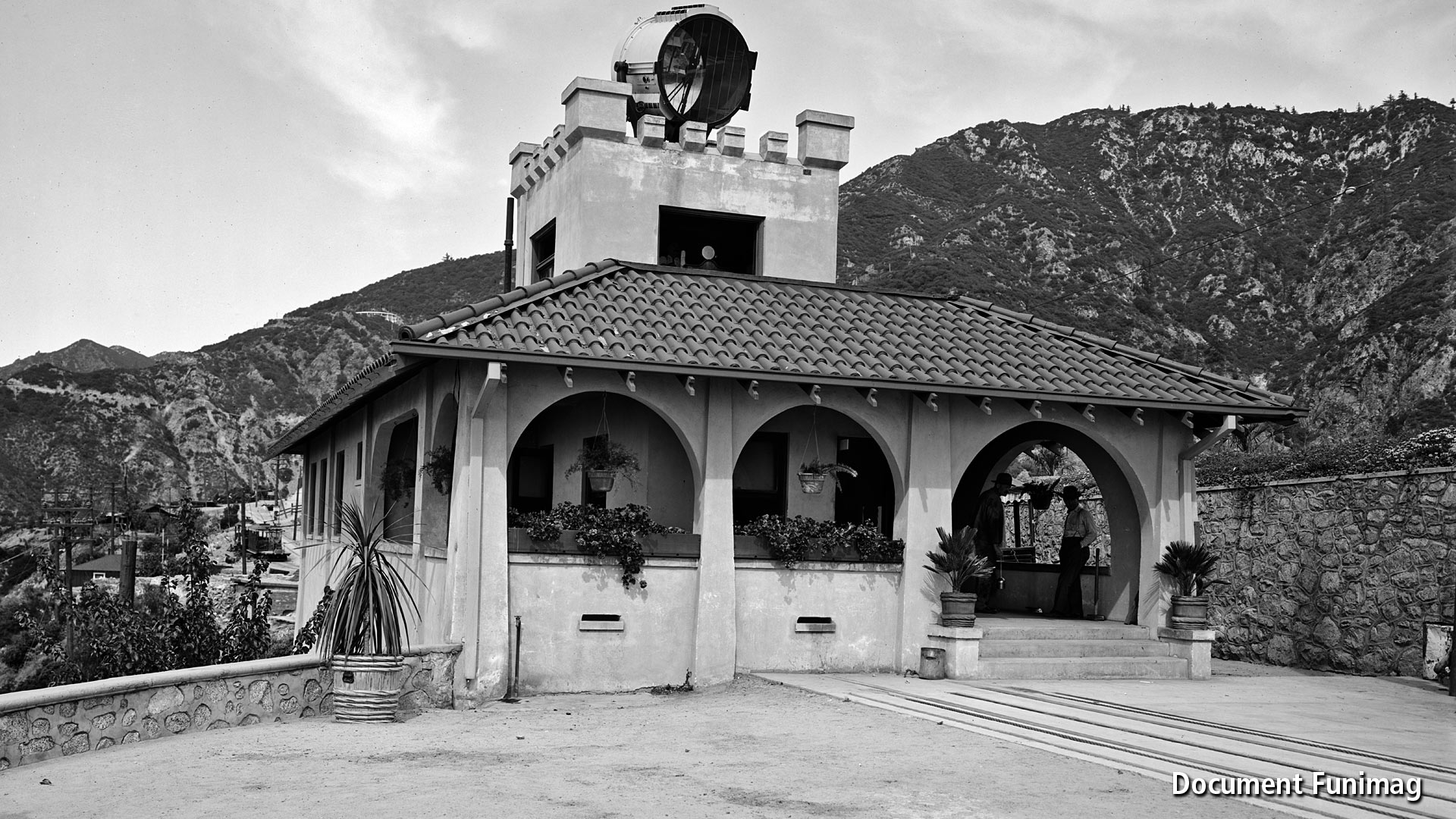
    On May 3, 2009… it was the Grand Opening for the public of the new Gravity Car replica barn and Museum at East Peak  which is the Mount Tamalpais & Muir Woods Railway old top station.
    The Barn will be the permanent home of the Gravity Car replica (N° 22) which is part of a was constructed by Jerry Coe in 1996. The Barn has been constructed over a section of the 84 feet of standard gauge track at the historic rail siding of the old top station.

    Un nouveau hangar pour la voiture

    Le 3 mai 2009, ce fut l’ouverture au public du nouveau hangar musée qui abrite la réplique d’une voiture de l’ancien chemin de fer gravitationnel Mount Tamalpais & Muir Woods Railway.
    Le hangar a été construit à l’East Peak à l’emplacement exact de l’ancienne gare supérieure du chemin de fer. Il servira d’abri à la voiture (N°22) qui a été construite par  Jerry Coe en 1996. La voiture est posée sur une section de 25 mètres de voie ferrée à écartement standard.

    Mount Tamalpais Gravity Railroad today
    (photo MoreMarin.com)
  • (US) The great era of (lost) American funiculars

    (US) The great era of (lost) American funiculars

    Introduction to lost American funiculars

    The United States of America was a great country of funiculars (inclines) but American people do not know or have forgotten these lost American funiculars.

    The United States of America has built the most spectacular funiculars but they have practically all disappeared for a long time.

    Here are more than fifty lost or stopped funiculars in order to remember what was the great era of American funiculars. This list is not exhaustive and is just a selection of the most representative ones.

    Index

    California New Jersey
    Colorado New York
    Florida Ohio
    Iowa Pennsylvania
    Michigan Tennessee
    Minnesota Utah
    Massachusetts Washington
    Montana West Virginia
    North Carolina Wisconsin
    New Hampshire  

    (click on photos to enlarge)

    California

    Catalina Island (1904-1923)

    Located on Catalina Island off Los Angeles, the incline was used to link Avalon and the amphitheater to Pebbly Beach on the other side of the hill.

    Lost American funiculars - Catalina Island
    Catalina Island (1904-1923)
    Court Flight (1905-1943)

    Court Flight incline was the other funicular in downtown Los Angeles. Not so famous as Angels Flight, which was opened in 1901 and is still active, Court Flight funicular linked Bunker Hill to Court Street.

    Lost American funiculars - Court Flight
    Court Flight (1905-1943)
    Fairfax Manor (1913-1930)

    Fairfax Manor Incline Railroad was used to access Manor Hill near Redwood in Marin County and promote promote sell lots.

    Fairfax Manor
    Fairfax Manor (1913-1930)
    Los Angeles – Mount Washington (1909-1919)

    The Los Angeles & Mount Washington Railway was a funicular which was built to develop the summit of Mt. Washington Hill.

    Lost American funiculars - Los Angeles - Mount Washington incline
    Los Angeles – Mount Washington (1909-1919)
    Mount Lowe (1893-1937)

    The Mount Lowe Great Incline was part of a great set of railways built to reach top of Mt. Lowe from Pasadena near Los Angeles.

    Mount Lowe Great Incline
    Mount Lowe (1893-1937)
    Playa Del Rey (1901-1909)

    This funicular was built to access the beach from Playa Del Rey, between the actual Marina Del Rey and Los Angeles International Airport.

    Lost American funiculars - Playa Del Rey
    Playa Del Rey (1901-1909)
    San Francisco – Fillmore Hill (1895-1941)

    The Fillmore Hill incline was an independent counterbalance funicular to climb from Broadway to Green and was not connected to the classical San Francisco cable cars.

    San Francisco - Fillmore Hill
    San Francisco – Fillmore Hill (1895-1941)
    San Francisco – Telegraph Hill (1884-1886)

    As Fillmore Hill, The Telegraph Hill incline was an independent counterbalance funicular to climb from Broadway to Green and was not connected to the classical San Francisco cable cars. It ran on Greenwich Street from Powell to the Pioneer Pavilion.

    Lost American funiculars - San Francisco - Telegraph Hill
    San Francisco – Telegraph Hill (1884-1886)
    Shasta Springs (1898-1950)

    Shasta Springs was a famous resort near Mount Shasta volcano in North California.

    Shasta Spring
    Shasta Springs (1898-1950)

    Colorado

    Golden Castle Rock (1913-1918)
    Lost American funiculars - Golden Castle Rock
    Golden Castle Rock (1913-1918)
    Golden Lookout Mountain (1912-1916)

    In 1912, the first funicular of Golden was built at top of the Lookout Mountain Park.

    Golden Lookout Mountain
    Golden Lookout Mountain (1912-1916)
    Mount Manitou Incline Railroad (1907-1989)

    Mount Manitou incline is certainly the most famous of US disappeared funiculars may be because it was recently closed. Its empty track is today used for vertical runs.

    Lost American funiculars - Mount Manitou Incline
    Mount Manitou Incline Railroad (1907-1989)
    Manitou Red Mountain (1912-1925)

    Few meters only from the famous Mount Manitou Incline and the Pike Peak Cog Railway, there was may be the most unknown US funicular… the Manitou Red Mountain Incline.

    Manitou Red Mountain
    Manitou Red Mountain (1912-1925)
    Mount Morrison (1909-1914)

    The Mount Morrison Incline Railroad was also an unknown and ephemeral funicular but as spectacular as those from Manitou Spring.

    Lost American funiculars - Mount Morrisson
    Mount Morrison (1909-1914)
    Royal Gorge Incline (1931-2013)

    The Royal Gorge Incline was in operation since recently but was forced to stop because of big damage after fire in the area.

    Royal Gorge Incline
    Royal Gorge Incline (1931-2013)
    Seven Falls (….-1992)

    Located near Colorado Springs, the Seven Falls is a famous natural spot. A funicular was first built to help visitors to access the gorge… today it is replaced by an underground vertical lift.

    Lost American funiculars - Seven Falls
    Seven Falls (….-1992)

    Florida

    Tampa Harbour Island People Mover (1985-1999)

    A very short life for this cable Automated People Mover which was built to link the Harbour Island to downtown Tampa in Florida. Today, every thing is gone.

    Tampa Harbour Island People Mover
    Tampa Harbour Island People Mover (1985-1999)

    Iowa

    Dubuque Eleventh Street (1883-1927)

    On 11th Street there was  the second funicular of Dubuque which was less famous than Fenelon Place Elevator which is on 4th Street.

    Lost American funiculars - Dubuque Eleventh Street incline
    Dubuque Eleventh Street (1883-1927)

    Michigan

    Kalamazoo Western Michigan College (1908-1949)

    This funicular was located inside Western Michigan University of Kalamazoo. In 2002 a replica was built by some students but it is only a static exposition.

    Kalamazoo Western Michigan College
    Kalamazoo Western Michigan College (1908-1949)
    Macatawa Lookout Pavillion (…-…)

    The Angel’s Flight Inclined Railway of Macatawa was built to reach the top of Lookout Point over Lake Michigan.

    Macatawa Lookout Pavillion
    Macatawa Lookout Pavillion (…-…)

    Minnesota

    Duluth 7th Avenue West (1891-1939)

    This is a very famous funicular which was a real icon of Duluth during more that 40 years.
    More informations about the Duluth 7th Avenue West Incline.

    Lost American funiculars - Duluth 7th Avenue West
    Duluth 7th Avenue West (1891-1939)

    Massachusetts

    Granite Railway and Incline– The first railroad in America (1826-1940)

    Granite Railway & Granite Incline were located south of Boston. They were the first railway and the first inclined railway in America. They were built in 1826 transport granite stone from Quincy quarry to erect the Bunker Hill Monument of Boston for the fiftieth anniversary of the Battle of Bunker Hill.
    More details about Granite Railway and its incline

    Granite Incline in 1934
    Granite Railway and Incline– The first railroad in America (1826-1940)
    Mount Holyoke Summit House (1858-1951)

    A tramway and a covered funicular was built to transport tourists to the Mont Holyoke Hotel at the top of the hill.

    Lost American funiculars - Mount Holyoke Summit House
    Mount Holyoke Summit House (1858-1951)
    Mount Tom Railroad (1897-?)

    Located new Holyoke, a railroad and a funicular were built to reach the summit of the Mount Tom above the western bank of the Connecticut River.

    Mount Tom Railroad
    Mount Tom Railroad (1897-?)

    Montana

    Lewis and Clark Caverns (1947-1973)

    Lewis and Clark Caverns were first accessible with a Jeep railway and a funicular. Unfortunately both of them were forced to close for administrative reasons.

    Lost American funiculars - Montana - Lewis and Clark Caverns
    Lewis and Clark Caverns (1947-1973)

    North Carolina

    Ghost Town in the Sky (1961-2002)

    Ghost Town in the Sky is a Wild West-themed amusement park on top of a mountain in Maggie Valley which was accessible by a double funicular composed of four cars of 48 passengers each. The park is now accessible by two chairlifts.

    Ghost Town in the Sky
    Ghost Town in the Sky (1961-2002)

    New Hampshire

    Cranmore Skimobile (1938-1989)

    Cranmore Skimobile was composed of 192 cable hauled cars in two sections to transport skiers and sightseers on top of Mount Cranmore in North Conway (New Hampshire).

    Lost American funiculars - Cranmore Skimobile
    Cranmore Skimobile (1938-1989)
    Uncanoonuc Incline Railway (1907-1941)

    Uncanoonuc Incline Railway and Development Company built an electric railway from Goffstown to the top of Mount Uncanoonuc near Manchester (New Hampshire).

    Uncanoonuc Incline Railway
    Uncanoonuc Incline Railway (1907-1941)

    New Jersey

    Hoboken wagon lift (1874-1928)

    The Hoboken wagon lift was a funicular used to lift vehicles from the foot of Paterson Plank Road to Jersey City Heights and close to the famous Hoboken Elevated Railway railway trestle.

    Lost American funiculars - Hoboken wagon lift
    Hoboken wagon lift (1874-1928)
    Morris Canal Inclined Planes (1830-1924)

    The Morris Canal was a 172 km canal used to transport coal on boats from Delaware river to Hudson river at Jersey City. There was 23 water-driven inclined planes the Morris Canal.

    Morris Canal Inclined Planes
    Morris Canal Inclined Planes (1830-1924)
    Weehawken wagon lift (1892-?)

    The Weehawken wagon lift was a funicular used to lift vehicles from the foot of Hackensack Plank Road to West Hoboken (now Union City).

    Lost American funiculars - Weehawken wagon lift
    Weehawken wagon lift (1892-?)
    West Orange Cable Road (1892-1906)

    The West Orange Cable Road was a cable railway up the mountain in West Orange.

    West Orange Cable Road
    West Orange Cable Road (1892-1906)

    New York

    Harriman Mansion (1904-1925)

    Edward Henry Harriman (1848–1909) director of the Union Pacific Railroad had a mansion built (today Arden House) on the heights of Turner (today Harriman, Orange County) with a funicular with a steam powered hoist to access it.

    Lost American funiculars - Harriman Mansion
    Harriman Mansion (1904-1925)
    Lake George Prospect Mountain (1895-1903)

    The Lake George Prospect Mountain railway was built by Otis to climb the top of Prospect Mountain west from Lake George City.

    Lake George Prospect Mountain
    Lake George Prospect Mountain (1895-1903)
    Mount Beacon Incline Railway (1901-1978)

    The Mount Beacon Incline Railway was a funicular railroad up to Mount Beacon at Beacon on left bank of Hudson River.

    Lost American funiculars - Mount Beacon Incline Railway
    Mount Beacon Incline Railway (1901-1978)
    New York – Brooklyn Bridge Cable Railway (1883-1908)

    At New York, Brooklyn Bridge is very famous as highway to cross East River but many people have forgotten that at the beginning there were special train shuttles that gripped a cable driven by a static steam engine and were then moved to the other track by steam locomotives for the next departure (From 24-Sep-1883 till end 27-Jan-1908).

    New York - Brooklyn Bridge Cable Railway
    New York – Brooklyn Bridge Cable Railway (1883-1908)
    Otis Elevating Railway – Catskill Mountain (1892-1918)

    The Otis Elevating Railway was a cable funicular railroad to the Catskill Mountain House in Palenville on right side of Hudson River.

    Lost American funiculars - Otis Elevating Railway - Catskill Mountain
    Otis Elevating Railway – Catskill Mountain (1892-1918)
    Rockland Lake Knickerbocker Ice Co. (1860-1924)

    Knickerbocker Ice Company mined the ice from Rockland Lake and to transport the blocks of ice to New York needed to build a steam-powered funicular to cross Hook Mountain and down to the Hudson River.

    Rockland Lake Knickerbocker Ice Co.
    Rockland Lake Knickerbocker Ice Co. (1860-1924)
    Sea Cliff Incline Railway (1886-1907)

    Located at Sea Cliff on Long Island, the Sea Cliff Incline Railway was used to transport passengers of steam boats from the dock to the top of the hill were was the Sea Cliff Hotel.

    Lost American funiculars - Sea Cliff Incline Railway
    Sea Cliff Incline Railway (1886-1907)
    Yonkers, Park Hill Elevator (1894-1937)

    At Yonkers, near Otis headquarter, an Otis hydraulic inclined elevator was built to link two Victorian buildings in Park Hill between 83 Alta Avenue and 32 Undercliff Street.

    Yonkers, Park Hill Elevator (1894-1937)
    Yonkers, Park Hill Elevator (1894-1937)

    Ohio

    Cincinnati

    The city of Cincinnati is famous to have been a great city of 6 early big funiculars mainly capable to transport streetcars and other vehicles on the top of the hills but in 1948 all the inclines were gone!

    Cincinnati / Bellevue Incline (1876-1926)

    Also known as the Cincinnati & Clifton Inclined Plane Railroad, the Bellevue Incline was able to transport tramway and other vehicles from Elm Street at McMicken Avenue to Ohio Avenue.

    Lost American funiculars - Cincinnati / Bellevue Incline
    Cincinnati / Bellevue Incline (1876-1926)
    Cincinnati / Fairview Incline (1892-1923)
    Cincinnati / Fairview Incline
    Cincinnati / Fairview Incline (1892-1923)
    Cincinnati / Mount Adams Incline (1876-1948)

    The Mount Adams & Eden Park Inclined Railway was the last and most famous funicular of Cincinnati. It was designed to transport street cars up to Adams Hill, the Zoo and Eden Park.

    Lost American funiculars - Cincinnati / Mount Adams Incline
    Cincinnati / Mount Adams Incline (1876-1948)
    Cincinnati / Mount Auburn Incline (1871-1898)

    The Mount Auburn or Main Street Incline was the first funicular of Cincinnati. First it was a passenger only incline than it was modified with an open platform to transport tramways and horse-driven vehicles.

    Cincinnati / Mount Auburn Incline
    Cincinnati / Mount Auburn Incline (1871-1898)
    Cincinnati / Price Hill Inclines (1874-1943)

    The Price Hill Inclines was composed of two separate funiculars. One was reserved for passengers only (on the left of the photo) and the other one was reserved for freight and vehicles.

    Lost American funiculars - Cincinnati / Price Hill Inclines
    Cincinnati / Price Hill Inclines (1874-1943)

    Pennsylvania

    Allegheny Portage Railroad (1834-1857)

    The Allegheny Portage Railroad was a 36-mile railroad built to cross the Allegueny Moutains and to link Johnstown on Conemaugh River and Hollydaysburg near Altoona. The railroad was able to transport canal boats on rail and over the moutain with 10 funicular inclined planes.

    More informations about Allegheny Portage Railroad.

    Allegheny Portage Railroad
    Allegheny Portage Railroad (1834-1857)
    Ashley Inclined Planes (1843-1948)

    The Hazleton Railroad was in charge to transport coal from Weatherly from top of the mountain down to the Lehigh River valley. Inclined planes were built at Penn Haven (actually Penn Junction) to reach the bottom of the valley.

    Lost American funiculars - Ashley Inclined Planes
    Ashley Inclined Planes (1843-1948)
    Penn Haven Inclines (1851-1864)

    The Hazleton Railroad was in charge to transport coal from Weatherly from top of the mountain down to the Lehigh River valley. Inclined planes were built at Penn Haven (actually Penn Junction) to reach the bottom of the valley.

    Penn Haven Inclines
    Penn Haven Inclines (1851-1864)
    PITTSBURGH

    Pittsburgh is unquestionably the American city that has had the most funiculars. The city counted up to 20 funiculars. Today there are only two: Monongahela Passenger Incline and Duquesne Incline.

    Pittsburgh – Castle Shannon Incline (1890-1964)

    The Castle Shannon Incline was carrying passengers and vehicles. It ran from Carson Street
    (near the present-day trolley tunnel) to Bailey Avenue on Mt. Washington. It was originally steam powered, and was converted to electric in 1918. Close to it there was also the Castle Shannon Coal Incline in charge to transport and the Castle Shannon South which was a kind of cable railroad to bring passengers to the main Castle Shannon Incline.

    Lost American funiculars - Pittsburgh - Castle Shannon Incline
    Pittsburgh – Castle Shannon Incline (1890-1964)
    Pittsburgh – Monongahela Freight Incline (1883-1935)

    The Monongahela Incline which is still in use since 1870 is the oldest funicular in USA (right on the photo). In 1883 a second incline was built just on the left of the 1870 passenger incline. The Monongahela Freight Incline (left on the photo) was reserved for freight and vehicles and was dismantled in 1935.

    Pittsburgh - Monongahela Freight Incline
    Pittsburgh – Monongahela Freight Incline (1883-1935)
    Pittsburgh – Mount Oliver Incline (1871-1951)

    The Mount Oliver Inclined Railway Company built an incline whose engine house was located on Mount Washington near Mount Oliver Street and down to the Southside.

    Lost American funiculars - Pittsburgh - Mount Oliver Incline
    Pittsburgh – Mount Oliver Incline (1871-1951)
    Pittsburgh – Norwood Incline (Penny Incline) (1901-1923)

    The Norwood Incline (or Penny Incline because a penny was charged to use it) ran from Island Avenue near Adrian Street to Desiderio Avenue between McKinnie Avenue and Highland Avenue McKees Rocks/Stowe.

    Pittsburgh - Norwood Incline (Penny Incline)
    Pittsburgh – Norwood Incline (Penny Incline) (1901-1923)
    Pittsburgh – Nunnery Hill Incline (1887-1899)

    The Nunnery Hill Incline was the first curved track incline in Pittsburgh. It linked Federal Street at Henderson Street (formerly Fairmount Street), North Side, to Catoma Street near Meadville Street (formerly Clyde Street).

    Lost American funiculars - Pittsburgh - Nunnery Hill Incline
    Pittsburgh – Nunnery Hill Incline (1887-1899)
    Pittsburgh – Penn Incline (1883-1953)

    The Penn Incline (or 17th Street Incline) was a freight, vehicles and passengers funicular railway from 17th Street between Liberty and Penn avenues in the Strip District to Arcena (Ridgeway) Street near Ledlie Street in the Hill District.

    Pittsburgh - Penn Incline
    Pittsburgh – Penn Incline (1883-1953)
    Pittsburgh – Knoxville Incline (1890-1960)

    The Knoxville Incline was the longest incline in Pittsburgh with 806 meters and a curve in the middle of the track. It was designed to transport freight, vehicles and passengers from Arlington Ave at Warrington on Mt. Washington down to Bradish Street on Southside.

    Lost American funiculars - Pittsburgh - Knoxville Incline
    Pittsburgh – Knoxville Incline (1890-1960)

    The links to the two remaining inclines of Pittsburgh still in use

    Dusquesne Incline

    Monongahela Incline

    Shohola Glen Switchback Gravity Railroad (1887-1908)

    The Shohola Glen Amusement Park in Pike County operated a switch back railroad from using passenger cars salvaged from the Pa. Coal Company Gravity Railroad that operated from Dunmore to Hawley. One section was an funicular inclined plane.

    Shohola Glen Switchback Gravity Railroad
    Shohola Glen Switchback Gravity Railroad (1887-1908)
    Mauch Chunk Switchback Gravity Railroad (1827-1933)

    The Mauch Chunk, Summit Hill & Switchback Gravity Railroad was first designed to transport anthracite from mines on hills down to Lehigh River. In 1874, the railroad was transformed into a tourist attraction that became one of the first roller coasters. Tourists in cars were pulled up two hills (Mount Pisgah and Mount Jefferson) then the cars were released to follow the railroad by gravity.

    Mauch Chunk Switchback Gravity Railroad
    Mauch Chunk Switchback Gravity Railroad – Mount Pisgah Incline (1827-1933)
    Mauch Chunk Switchback Gravity Railroad
    Mauch Chunk Switchback Gravity Railroad – Mount Jefferson Incline (1827-1933)

    Tennessee

    Chattanooga – Lookout Mountain First Incline (1886-1898)

    The Lookout Mountain Incline was the first Incline (Incline n°1) at Chattanooga to climb to the Lookout Mountain at the old Point Hotel. This incline was located few meters beside the actual Lookout Mountain Incline (Incline n°2) which was built in 1896 and then replaced the incline n°1.

    Chattanooga - Lookout Mountain First Incline
    Chattanooga – Lookout Mountain First Incline (1886-1898)

    UTAH

    Kennecott Copper Mine – Bingham Canyon Incline (1909-1970)

    The Kennecott Copper Mine (today Rio Tinto Kennecott) is famous for its big open pit mine near Salt Lake City. During decades inside this big pit there was a real village called Bingham Canyon with many railroads. The village was located at the bottom of the canyon and the train station was on the top of the hill. A funicular was built to reach the village from the train station until 1970 when the village was abandoned and destroyed to expand the open pit mine.

    Kennecott Copper Mine - Bingham Canyon Incline
    Kennecott Copper Mine – Bingham Canyon Incline (1909-1970)

    Washington

    Seattle – Washington Hotel (1901-1907)

    The Washington Hotel (first named Denny Hotel) was built in 1889 on top of Denny Hill. To reach the entrance of the hotel from Third Avenue a short inclined railway was built. The hotel was demolished in 1907 during the regrade of Denny Hill.

    eattle - Washington Hotel
    Seattle – Washington Hotel (1901-1907)
    Diablo Dam – Skagit Incline (1920-2001)

    May be one of the most spectacular inclined plane ever built. The Skagit Incline was part of the Skagit Electric railway and was built to carried loaded freight cars and locomotives broadside up the hill to the Diablo Dam. The inclined plane was stopped after September 11 2001 terrorist attack for security reason but is still visible.

    Diablo Dam - Skagit Incline
    Diablo Dam – Skagit Incline (1920-2001)

    West Virginia

    Mozart Park, Wheeling (1893-1907)

    In 1893, a recreational park was built on top of the hill near Mozart area. To link the new Mozart Park to South Wheeling, an incline railway was built near 43rd Street. It operated until 1907 and was replaced by a street car. The Mozart Park itself remained open until 1917.

    Mozart Park, Wheeling
    Mozart Park (1893-1907)

    Wisconsin

    Milwaukee Shorewood – Atwater Park (1967-1977)

    At Shorewood, near Milwaukee, a funicular was built in 1967 at Atwater Park to reach the beach 30 meters down. The two carriages were names “Able Cable” and “Twinkle Toes”. The cliff railway was dismantled in 1987.


    Milwaukee Shorewood - Atwater Park
    Milwaukee Shorewood – Atwater Park (1967-1977)

    First published on September 16th, 2017
    Updated on January 13, 2023
    Copyright © 2025 Funimag – Michel Azéma, Paris (France)

  • Fairfax Manor Incline New Photo

    Fairfax Manor Incline New Photo

    Great and rare photo of the Fairfax Manor Inclined Railroad (1913-1930) in Marin County (California). It was an inclined railway with only one carriage and a counterweight. The carriage was rolling on the external pair of rails while the counterweight used the internal pair of rails. So… the counterweight was flat and passed under the carriage at the middle point.

    Nouvelle photo du Fairfax Manor Incline

    Exceptionnelle et donc rare photo du Fairfax Manor Inclined Railroad (1913-1930) dans le Comté de Marin (Californie).
    Ce fut un funiculaire, aujourd’hui complètement disparu, à quatre rails avec une seule cabine et un contrepoids.
    La cabine roulait sur la paire de rails extérieurs alors que le contrepoids utilisait les rails intérieurs.
    Le contrepoids était donc plat et passait sous la cabine à mi-parcours.

    Fairfax Manor Inclined Railroad
    Fairfax Manor Inclined Railroad

    Thanks to Joe Thomson and Guy Span for the photo in Northwestern Pacific Railroad Historical Society.

  • Two videos about Mount Lowe memories

    Two interesting videos about Mount Lowe memories (California)

    Deux vidéos très intéressantes sur la mémoire du Mount Lowe (Californie)

    First a video made by Mount Lowe Preservation Society
    Tout d’abord une vidéo faite par la société de préservation du Mont Lowe

    Then a great ‘Then & Now’ video about the remains on Mount Lowe
    Ensuite une excellente vidéo qui présente le Mount Lowe à la manière de ‘Avant & Maintenant’

  • New article – (US) Granite Railway – The first railroad in America (1826)

    New article – (US) Granite Railway – The first railroad in America (1826)

    Granite Railway

    NEW ARTICLE IN FUNIMAG
    Today, in the fixed pages (Articles) of this blog, you will find a new article about the first railroad and the first inclined railway in America :

     (US) Granite Railway – The first railroad in America (1826)

    GRANITE RAILWAY & GRANITE INCLINE at Quincy, Massachusetts, USA
    The story of the first railway and the first inclined railway in America (1826).
    Built to transport granite stones from Quincy quarries to the Bunker Hill Monument at Boston.

    Click here to read the article…

     (US) Granite Railway – Le premier chemin de fer d’Amérique (1826)

    GRANITE RAILWAY & GRANITE INCLINE à Quincy, Massachusetts, USA
    L’histoire du premier chemin de fer et premier plan incliné funiculaire d’Amérique (1826).
    Construit pour transport des blocs de granit nécessaire à la construction du monument en mémoire à la bataille de Bunker Hill à Boston.
    Cliquez ici pour lire l’article…